
Quick Answer:
Unique Italian boy names combine Italian linguistic heritage, distinctive sounds, and connections to art, history, and traditional naming. Consider Elio, an Italian form of Aelius also associated with Helios; Cosimo, the Italian form of Cosmas; Dante, the name of the celebrated medieval Italian poet; and Lapo, an Italian diminutive of Jacopo.
These names offer different kinds of individuality without relying on invented meanings or unsupported claims of rarity.
Choosing a name for your baby boy can be easier when you look beyond familiar Italian favorites and explore names with distinctive histories, compact spellings, or strong connections to Italian culture. Some options come from ancient Roman naming traditions, while others are established Italian forms of names used across Europe.
The word unique does not necessarily mean statistically rare. A name can be genuinely Italian yet familiar in Italy, or historically established but less familiar to English speaking parents.
This guide focuses on authentic Italian masculine names, explains their origins carefully, and highlights options that stand out for different reasons.
Unique Italian Boy Names With Meanings
These names are a useful starting point if you want something distinctive without sacrificing cultural authenticity.
| Name | Meaning or origin | What makes it distinctive |
| Elio | Italian form of Aelius; also associated with Helios | Short, vowel rich sound |
| Cosimo | Italian form of Cosmas | Strong Renaissance connection |
| Dante | Medieval Italian short form of Durante | Literary and historical associations |
| Lapo | Italian diminutive of Jacopo | Compact, traditional Italian form |
| Leone | Italian form of Leo and Leon | Lion related name roots |
| Ennio | Italian form of the Roman family name Ennius; meaning unknown | Ancient Roman heritage |
| Tullio | Italian form of Tullius; ultimate meaning unknown | Classical Roman character |
| Ciro | Italian form of Cyrus | Brief, recognizable Italian form |
| Orlando | Italian form of Roland | Medieval literary heritage |
| Ottavio | Italian form of Octavius | Classical Roman roots |
| Duilio | From the Roman family name Duilius; possibly connected with Latin duellum, meaning “war” | Ancient historical association |
| Cosmo | Italian variant of Cosimo | A concise alternative to Cosimo |
These names have different linguistic and historical backgrounds. The original meanings of Ennio and Tullio are uncertain, so it is better not to assign them definitive translations.
Distinctive Italian Boy Names With Ancient Roman Roots
Ancient Roman history offers another route to an Italian name connected to a long cultural tradition. Some modern Italian names developed from Roman family names or personal names, although their original meanings are not always known.
Ennio
Ennio is an Italian form of the Roman family name Ennius. Quintus Ennius was an early Roman poet, giving the name a documented literary association. Its original meaning remains unknown.
Tullio
Tullio is the Italian form of Tullius, derived from the Roman personal name Tullus. It is historically associated with Marcus Tullius Cicero, the Roman orator and author. The underlying meaning is uncertain.
Ottavio
Ottavio is the Italian form of Octavius, a Roman name. Its classical background makes it worth considering if you want an established historical name rather than a newly invented spelling.
Duilio
Duilio derives from the Roman family name Duilius. Its connection to Latin duellum, meaning “war,” is a possible etymology rather than a certainty.
These names are historically grounded, but ancient origins alone do not establish how common or uncommon a name is among babies born today.
Unique Italian Boy Names Inspired by Literature and History
Italian culture has a rich literary and artistic history. A name connected to a writer, historical figure, or literary tradition can provide a meaningful point of connection without requiring a symbolic meaning that the name does not actually possess.
| Name | Historical or cultural connection | Why consider it |
| Dante | Dante Alighieri, the medieval Italian poet | A concise name with a major literary association |
| Orlando | Italian chivalric literature, including Orlando Furioso | A traditional name with an epic literary history |
| Cosimo | Cosimo de’ Medici and Renaissance Florence | Strong historical and artistic associations |
| Tullio | Marcus Tullius Cicero and Roman literature | A classical alternative with an Italian form |
| Ennio | Quintus Ennius, an early Roman poet | A compact name with ancient literary roots |
Dante is a medieval short form of Durante, and Orlando is the Italian form of Roland. Cosimo is the Italian form of Cosmas. These relationships provide more reliable explanations than assigning each name an appealing but unsupported modern meaning.
Short and Distinctive Italian Boy Names
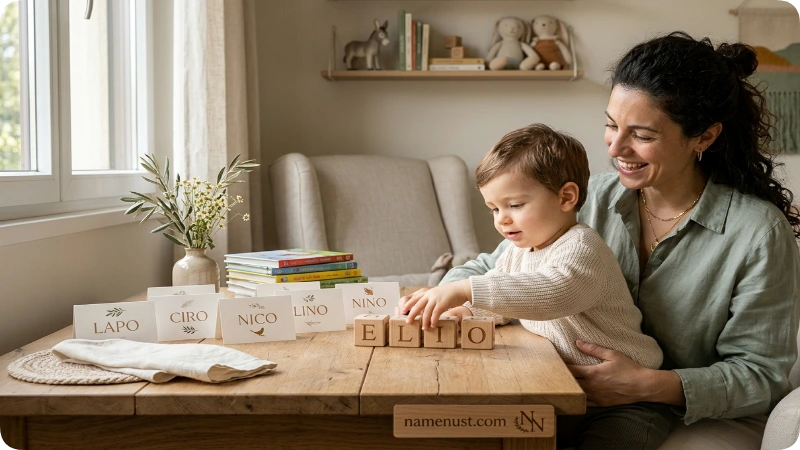
If you prefer a name that is easy to write and relatively compact, consider these established Italian options. Short names are not automatically rare, and several are used in multiple languages.
- Elio: An Italian and Spanish form of Aelius, also used as the Italian form of Helios.
- Lapo: An Italian diminutive of Jacopo, rather than an unrelated name with a separate established meaning.
- Ciro: An Italian, Spanish, and Portuguese form of Cyrus.
- Nico: Used in Italian and several other languages as a short form of Nicholas or sometimes Nicodemus.
- Lino: An Italian form of Linus, with other uses across Romance languages.
- Nino: An Italian short form of names such as Giannino and Antonino.
A useful distinction: Nico and Lino are international in use, while Lapo has a more specifically Italian diminutive history. If your priority is a name strongly tied to Italian naming conventions, that difference may matter more than the number of letters.
Italian Boy Names With Distinctive Sounds
Italian names often feature clear vowel endings and consonant combinations that may sound different from their English language counterparts. The following choices provide variety without depending on unusual spellings.
| Name | Origin or relationship | Distinguishing feature |
| Cosimo | Italian form of Cosmas | Three syllables and a recognizable Italian ending |
| Leone | Italian form of Leo and Leon | A longer alternative to Leo |
| Orlando | Italian form of Roland | A flowing, three syllable form |
| Tullio | Italian form of Tullius | A distinctive double consonant spelling |
| Duilio | From Roman Duilius | A less familiar looking classical form |
| Enzo | Italian and French usage; origin uncertain | Short and recognizable |
Enzo deserves a qualification. It may be an older Italian form related to Heinz, a variant of the Germanic name Anzo, or a short form of names ending in enzo, such as Vincenzo and Lorenzo. It is best not to assign it one definitive meaning.
Traditional Italian Boy Names Worth Considering

A distinctive choice does not have to be obscure. A traditional name may be the better fit if you want a clear connection to Italian family, language, or cultural heritage.
- Leonardo: The Italian form of Leonard, with Germanic roots associated with lion and bravery.
- Alessandro: The Italian form of Alexander, ultimately derived from Greek elements associated with defending or protecting people.
- Francesco: The Italian form of Franciscus, historically associated with a French person or someone from France.
- Lorenzo: The Italian form of Laurentius, traditionally connected to Laurentum.
- Matteo: The Italian form of Matthew, a name with Hebrew roots traditionally interpreted as “gift of God.”
- Domenico: The Italian form of Dominicus, from Latin Dominicus, associated with the Lord.
- Pietro: The Italian form of Peter, from Greek Petros, meaning “stone” or “rock.”
- Gabriele: The Italian form of Gabriel, a name of Hebrew origin traditionally interpreted as “God is my strength.”
These are established Italian masculine forms, but they differ in linguistic origin and religious or historical association. A name’s use in Italy does not, by itself, make it exclusively Italian.
Are these names actually uncommon in Italy?
Not necessarily. Official Italian birth name statistics for 2024 list Leonardo in first place, followed by Edoardo and Tommaso. Mattia and Alessandro also appear among the leading names. This demonstrates that a name can be distinctly Italian without being statistically unusual.
For a more individual choice, consider a historically established name such as Lapo, Tullio, or Duilio. However, without checking official birth records for a specific year and region, it would be misleading to label any of them definitively rare.
How to Choose a Unique Italian Boy Name

A good shortlist balances sound, cultural authenticity, family significance, and everyday practicality.
- Decide what “unique” means to you. You might prefer an uncommon sounding name, a historical name, or a recognizable Italian form that is less familiar among your family and friends.
- Check the original name relationship. Determine whether a name is genuinely Italian in form, an Italian diminutive, or an international name also used in Italy.
- Verify the meaning. If a name’s origin is uncertain, treat that uncertainty as part of the decision rather than relying on a simplified meaning from a name list.
- Say it aloud with your surname. Consider the rhythm, spelling, and likely pronunciation in the languages your child may use.
- Think about nicknames. Enzo can be a name in its own right or a short form in some contexts; Lapo is already a diminutive of Jacopo. Decide whether you prefer a standalone name or one with a longer form.
- Check current popularity if rarity matters. Official statistics can show how frequently a name was registered in a particular country and year. They cannot prove that a name is rare everywhere.
Italian pronunciation: a few helpful details
Italian pronunciation differs from English in several predictable ways. The letter combination ci before o or a usually represents a “ch” sound, which helps explain the Italian pronunciation of Ciro. The combination gli and other Italian letter patterns can also be unfamiliar to English speakers, so check a language specific pronunciation reference for any shortlisted name.
If you live outside Italy, it is worth considering how a name will be read by Italian speakers as well as by the people who will use it most often in your child’s daily life.
Frequently Asked Questions
What are some unique Italian boy names?
Elio, Lapo, Cosimo, Tullio, Ennio, and Duilio are good options to explore. They have documented Italian usage or Italian name histories, although their statistical rarity varies and should not be assumed without birth name data.
Which Italian boy names have historical significance?
Dante is associated with Dante Alighieri, Cosimo with the Medici family and Renaissance Florence, and Tullio with the Roman orator Cicero. These are historical associations, not claims that the names themselves have particular personality traits.
Are Italian boy names always of Italian origin?
No. Italian names may be Italian language forms of Greek, Hebrew, Latin, or Germanic names. Leonardo, Matteo, and Alessandro illustrate how a name can be authentically Italian in form while having roots in another language or naming tradition.
How can I tell whether an Italian boy name is rare?
Look for official birth name statistics for the country and period that matter to you. Italy’s National Institute of Statistics (ISTAT) provides Italian birth name data, including annual rankings and a name counter for registered births. A name that is uncommon in one country may be familiar in another.
Should I choose a name for its meaning or its cultural history?
Either approach can work. If a particular meaning matters most, prioritize a name with a defensible etymology. If cultural or family heritage matters more, a name’s documented use, historical associations, or relationship to a family name may be more meaningful than a single word translation.
Conclusion
Unique Italian boy names offer several paths to a distinctive choice, from the concise Elio and Lapo to the literary Dante and the classical Tullio.
Start with the names whose sound and history appeal to you, verify their meanings rather than relying on popular interpretations, and check official statistics if rarity is a major priority.
The strongest choice is one that feels right for your family while respecting the name’s actual cultural and linguistic history.

Noah Mitchell is a passionate Name Researcher and Content Writer at Namenust.com. He specializes in creating well-researched content about name meanings, origins, history, cultural significance, and modern naming trends. His goal is to help readers discover unique, meaningful, and inspiring names for babies, businesses, characters, and more. Through informative and engaging articles, Noah makes name research simple, accurate, and enjoyable for readers around the world.