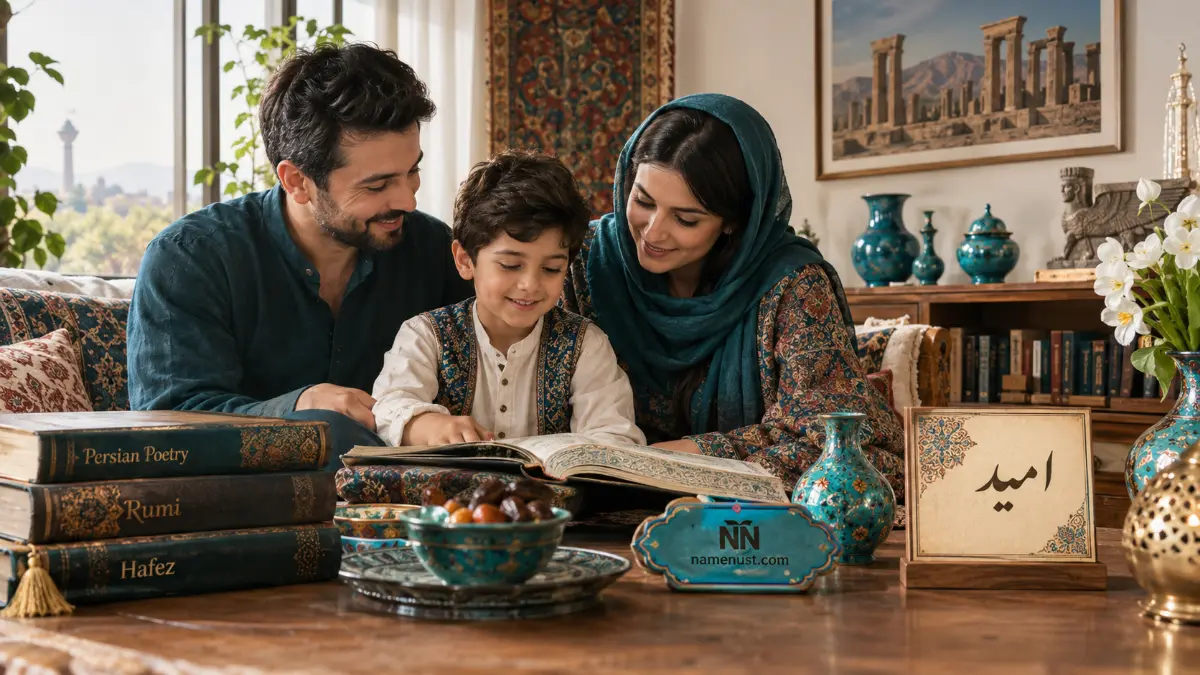
Persian boy names reflect a rich heritage shaped by the Persian language, ancient Iranian history, literature, and cultural traditions. Names such as Omid, meaning “hope,” Navid, meaning “good news,” and Azad, meaning “free,” offer meaningful choices rooted in Persian vocabulary.
Other names, including Dariush, Kourosh, Arash, and Rostam, connect with historical figures and legendary stories.
If you prefer a short modern name, a traditional choice, or a name inspired by Persian mythology, understanding its meaning and background can help you find a name that suits your family.
Traditional Persian Boy Names
Traditional Persian boy names connect generations through language, history, and literature. Some come from ancient Iranian naming traditions, while others remain familiar through Persian poetry and cultural storytelling.
| Name | Meaning or Association | Origin |
| Dariush (داریوش) | Holding firm to the good | Ancient Iranian |
| Kourosh (کوروش) | Exact meaning disputed | Ancient Iranian |
| Arash (آرش) | Legendary archer | Persian mythology |
| Bahman (بهمن) | Good mind | Ancient Iranian and Zoroastrian tradition |
| Siavash (سیاوش) | Traditionally interpreted as possessing black stallions | Persian mythology |
| Soroush (سروش) | Associated with obedience | Iranian religious tradition |
| Rostam (رستم) | Celebrated epic hero | Persian literature |
| Kaveh (کاوه) | Legendary blacksmith | Iranian mythology |
| Farhad (فرهاد) | Exact etymology uncertain | Persian literary tradition |
| Dara (دارا) | Commonly interpreted as possessor | Persian |
Dariush and Kourosh may appeal to parents who appreciate ancient Iranian history. Arash, Rostam, and Kaveh have strong connections with Persian legendary stories, while Bahman and Soroush have associations with older Iranian religious traditions.
Persian Boy Names With Beautiful Meanings
If you want a name with a meaningful translation, Persian vocabulary offers several appealing options. The following names have established meanings in modern Persian, although some historical name origins may be more complex than their everyday definitions.
| Name | Meaning | Origin |
| Omid (امید) | Hope | Persian |
| Navid (نوید) | Good news; glad tidings | Persian |
| Azad (آزاد) | Free | Persian |
| Arman (آرمان) | Aspiration; ideal | Persian |
| Payam (پیام) | Message | Persian |
| Parsa (پارسا) | Pious; virtuous | Persian |
| Kamran (کامران) | Fortunate; successful | Persian |
| Farzan (فرزان) | Wise; learned | Persian |
| Behzad (بهزاد) | Commonly interpreted as well born | Persian |
| Mehrdad (مهرداد) | Traditionally interpreted as given by Mithra | Iranian |
| Bahram (بهرام) | Associated with victory | Iranian |
| Kian (کیان) | Associated with royal lineage or the Kayanian tradition | Persin |
Persian Boy Names Meaning Hope and Happiness
Omid is a straightforward choice because it means “hope” in Persian. Navid means “good news,” making it suitable for parents who associate their child’s arrival with happiness and a new beginning.
Kamran is associated with good fortune and success, while Arman refers to an aspiration or ideal. These names have different linguistic meanings, but each can carry personal significance for a family.
Persian Boy Names Meaning Wisdom and Virtue
Farzan is associated with wisdom and learning, while Parsa is associated with piety and virtue. Bahman has a deeper connection to the Iranian religious concept of the good mind.
If you are choosing a name for its meaning, distinguish a direct dictionary translation from a traditional interpretation or symbolic association.
Persian Boy Names From Mythology and Epic Literature
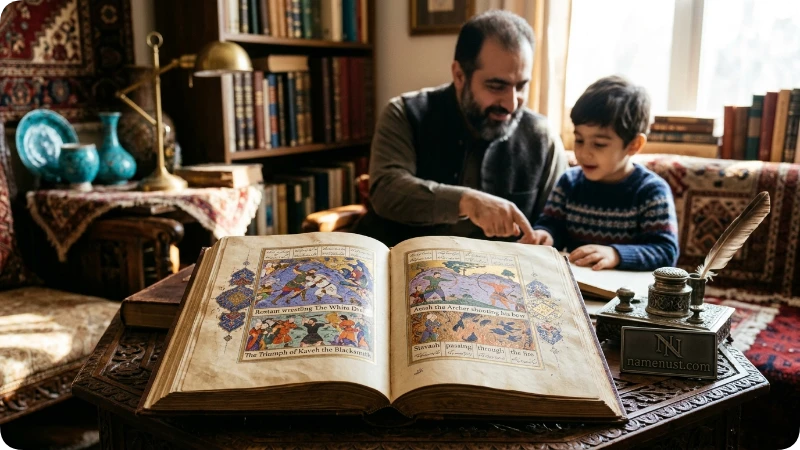
Persian literature preserves memorable characters whose names continue to be used as given names. Ferdowsi’s Shahnameh, or Book of Kings, is particularly important to Iranian literary heritage.
Arash
Arash is the name of a legendary archer in Iranian tradition. His story describes an arrow that establishes a boundary between Iran and Turan. The legend connects the name with courage, sacrifice, and devotion, although these qualities are associations with the story rather than a verified literal translation.
Rostam
Rostam is one of the most celebrated heroes in Persian epic literature. His adventures in the Shahnameh make the name a meaningful choice for families who appreciate traditional Iranian storytelling.
The name is best understood through its literary significance rather than an uncertain or oversimplified translation.
Kaveh
Kaveh the Blacksmith is a legendary figure associated with resistance against the tyrannical ruler Zahhak. His story has become an important symbol of standing against oppression in Iranian cultural tradition.
Parents who appreciate names with stories of resistance and courage may find Kaveh especially appealing.
Siavash
Siavash is a prince in Persian mythology whose story explores themes of virtue, injustice, and suffering. His name is traditionally explained as referring to the possession of black stallions.
It offers a connection with Persian epic literature and a character remembered for his moral qualities.
Ancient Persian Boy Names With Historical Roots
Ancient Iranian history provides names associated with rulers, royal families, and early Iranian languages. Some have familiar English forms, while others retain spellings closer to modern Persian.
| Name | Historical Connection | Naming Consideration |
| Cyrus | Associated with Cyrus the Great | Familiar internationally; exact ancient etymology disputed |
| Kourosh | Modern Persian form associated with Cyrus | Reflects Persian linguistic usage |
| Darius | English form of an ancient Iranian royal name | Established historical form |
| Dariush | Modern Persian form of Darius | Reflects contemporary Persian usage |
| Xerxes | Greek transmitted form of an ancient Iranian royal name | Strong historical association |
| Artaxerxes | Name of several Achaemenid kings | Longer, formal historical name |
| Hystaspes | Ancient Iranian personal and royal name | Uncommon historical choice |
| Ariaramnes | Name associated with the Achaemenid royal family | Distinctive ancient name |
Cyrus or Kourosh?
Cyrus and Kourosh are related forms of the historical name associated with Cyrus the Great. Cyrus is widely familiar in English, while Kourosh reflects the modern Persian form.
The original name’s etymology is disputed, so popular claims that it definitively means “sun” should be treated cautiously.
Darius or Dariush?
Darius is the familiar English form, while Dariush is the modern Persian form associated with the ancient Iranian name. Its historical interpretation is commonly expressed as “holding firm to the good” or “retaining the good.”
Choosing between the two can depend on family heritage, pronunciation, and the language in which the name will most often be used.
Short Persian Boy Names
Short Persian boy names can be practical for families who prefer simple spellings and concise sounds. Some are direct Persian words, while others have broader regional usage.
| Name | Meaning or Association | Origin |
| Omid (امید) | Hope | Persian |
| Dara (دارا) | Possessor; commonly interpreted as having or possessing | Persian |
| Azad (آزاد) | Free | Persian |
| Kian (کیان) | Royal lineage or Kayanian association | Persian |
| Mehr (مهر) | Affection; kindness | Persian |
| Sina (سینا) | Associated with the historical name of Avicenna | Persian and wider regional usage |
| Arman (آرمان) | Aspiration; ideal | Persian |
| Ramin (رامین) | Established Persian literary name; exact etymology uncertain | Persian |
Omid, Azad, and Arman are useful options if you prefer names with recognizable word meanings. Kian and Ramin may appeal to parents looking for traditional given names.
Keep in mind that short names are not necessarily exclusive to Persian speaking communities. Some have established usage across several languages and regions.
Modern Persian Boy Names
Modern Persian names combine contemporary everyday usage with longstanding linguistic and cultural traditions. A modern choice does not have to be newly invented; many familiar names preserve older Persian words or historical forms.
| Name | Meaning or Association | Style |
| Navid (نوید) | Good news | Meaningful and concise |
| Omid (امید) | Hope | Simple and traditional |
| Arman (آرمان) | Aspiration; ideal | Contemporary Persian usage |
| Kamran (کامران) | Fortunate; successful | Established traditional name |
| Farzan (فرزان) | Wise; learned | Intellectual association |
| Kian (کیان) | Royal lineage or Kayanian association | Short and traditional |
| Dariush (داریوش) | Holding firm to the good | Historical Persian form |
| Shervin (شروین) | Exact etymology uncertain | Established Iranian given name |
When choosing a modern Persian name, consider how it sounds with your surname, whether you want to preserve the Persian script, and how easily relatives and friends can pronounce it.
Persian Boy Names Associated With Strength and Leadership
Some families prefer names that evoke courage, independence, victory, or leadership. For these names, it is important to distinguish a literal meaning from the qualities associated with a historical or legendary figure.
| Name | Meaning or Association | Type |
| Azad | Free | Direct Persian word meaning |
| Bahram | Associated with victory | Historical and mythological association |
| Arash | Legendary archer | Heroic literary association |
| Rostam | Celebrated epic hero | Persian literature |
| Kaveh | Legendary opponent of tyranny | Iranian mythology |
| Dariush | Ancient royal name associated with holding firm to the good | Historical and linguistic connection |
| Kourosh | Name associated with Cyrus the Great | Royal and historical association |
Azad is a particularly clear choice if you want a direct meaning associated with freedom. Arash, Rostam, and Kaveh may be more suitable if you prefer a name whose cultural story evokes courage or leadership.
Not every ancient royal name literally means “king” or “warrior.” Understanding a name’s historical background is more reliable than relying on an attractive but unsupported translation.
Persian Boy Names and Zoroastrian Traditions
Persian naming traditions include names connected with Zoroastrianism, an ancient religion that developed in the Iranian world. Some names have Avestan roots, while others are Persian forms associated with religious figures, concepts, or older Iranian traditions.
| Name | Meaning or Association | Cultural Context |
| Bahman (بهمن) | Good mind | Connected with Vohu Manah in Zoroastrian tradition |
| Soroush (سروش) | Associated with obedience | Connected with the Avestan Sraoša |
| Mehrdad (مهرداد) | Traditionally interpreted as given by Mithra | Iranian religious and historical naming tradition |
| Bahram (بهرام) | Associated with victory | Ancient Iranian religious and mythological associations |
| Adar | Fire | Associated with Iranian religious traditions surrounding sacred fire |
These names should not automatically be classified as exclusively religious in modern usage. A name can preserve a Zoroastrian association while also being used culturally by people from different religious backgrounds.
Likewise, Persian origin alone does not establish whether a name is Muslim, Zoroastrian, or associated with another faith. Families seeking a specific religious connection should examine each name’s history individually.
How to Choose the Right Persian Boy Name
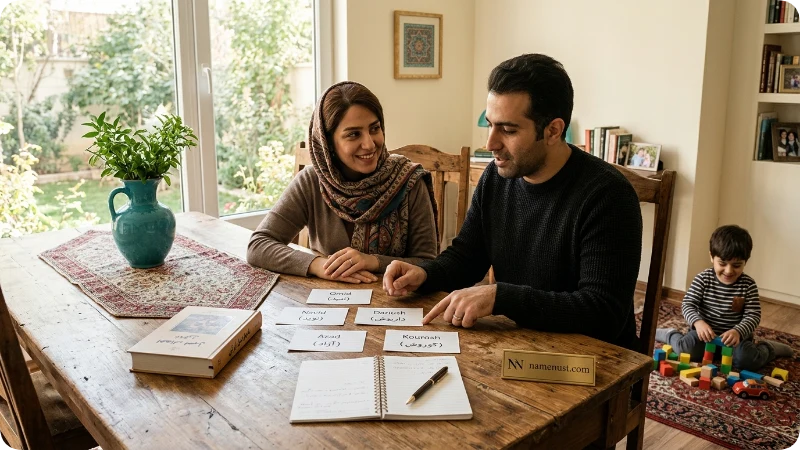
Choosing a name involves more than finding an appealing sound. Meaning, pronunciation, family heritage, and cultural significance can all help you make a confident decision.
1. Decide Which Meaning Matters Most
If you want a direct word meaning, consider Omid, Navid, or Azad. If you prefer a name connected with ancient history, Dariush and Kourosh may be better choices.
Remember that a dictionary meaning and a historical interpretation are not always identical.
2. Consider Pronunciation and Spelling
Think about how the name will be pronounced in Persian and in other languages spoken by your family.
For example, Cyrus and Kourosh are related forms associated with the same historical name, but they reflect different linguistic traditions. Choosing one spelling can help preserve the pronunciation or cultural connection you prefer.
3. Think About Your Family’s Heritage
Some families prefer names from Persian literature, while others choose names based on modern Persian vocabulary. Both approaches can reflect a meaningful connection with Persian culture.
Consider whether you want the name to honor a family member, preserve a cultural tradition, or simply express a meaning that matters to you.
4. Verify Uncertain Meanings
Baby name websites sometimes assign several meanings to one name without explaining their sources. Names such as Cyrus and Arash have uncertain or disputed etymologies.
You do not need a perfectly settled translation to choose a name, but you should understand which parts of its meaning are established and which are traditional interpretations.
5. Say the Full Name Aloud
Try the first name with your surname and consider how it sounds in everyday conversation. If your family speaks multiple languages, check how the name works in each one.
A name that feels natural in daily life and has a background you value can be a stronger choice than one selected solely for its appearance on paper.
Frequently Asked Questions About Persian Boy Names
What are some Persian boy names to consider?
Omid, Navid, Arash, Kian, Dariush, Kourosh, Kamran, and Rostam are options worth exploring. They represent different traditions, including Persian vocabulary, ancient Iranian history, and Persian epic literature. This selection is not a verified popularity ranking.
Which Persian boy names have meaningful origins?
Omid means “hope,” Navid means “good news,” and Azad means “free” in Persian. Dariush is associated with the interpretation “holding firm to the good,” while Arash is known as the name of a legendary Iranian archer. The latter names have historical or literary associations beyond a simple dictionary meaning.
Are Persian and Arabic boy names the same?
No. Persian and Arabic are different languages with distinct linguistic histories. Persian names can have Iranian roots, while Arabic names originate in Arabic. Historical and religious contact has led to shared naming practices, but shared usage does not make the origins identical.
Are Persian boy names automatically Muslim names?
No. Persian names can have pre Islamic Iranian, Zoroastrian, historical, literary, or modern linguistic origins. Some are widely used by Muslims, but Persian linguistic origin alone does not establish a name’s religious classification.
What is the difference between Cyrus and Kourosh?
Cyrus is the familiar English form transmitted through Greek and Latin, while Kourosh is the modern Persian form associated with the ancient name. Both are connected with Cyrus the Great, and the original name’s exact etymology remains disputed.
Are Persian boy names suitable for families living outside Iran?
Yes. Families with Iranian heritage and families who appreciate Persian language and literature may choose these names. Consider the spelling, pronunciation, intended meaning, and cultural background before deciding. Some names also have familiar forms in other languages, which can be useful in multilingual households.
Conclusion
Persian boy names offer choices rooted in language, ancient history, mythology, literature, and religious traditions. Omid, Navid, and Azad are good options if you prefer clear Persian word meanings, while Dariush and Kourosh connect with ancient Iranian history.
Arash, Rostam, Kaveh, and Siavash offer cultural significance through Persian epic storytelling.As you create your shortlist, choose a name whose meaning, pronunciation, and background fit your family.
When an etymology is uncertain, an honest explanation is more valuable than an attractive but unsupported definition.

Noah Mitchell is a passionate Name Researcher and Content Writer at Namenust.com. He specializes in creating well-researched content about name meanings, origins, history, cultural significance, and modern naming trends. His goal is to help readers discover unique, meaningful, and inspiring names for babies, businesses, characters, and more. Through informative and engaging articles, Noah makes name research simple, accurate, and enjoyable for readers around the world.