Quick Answer:
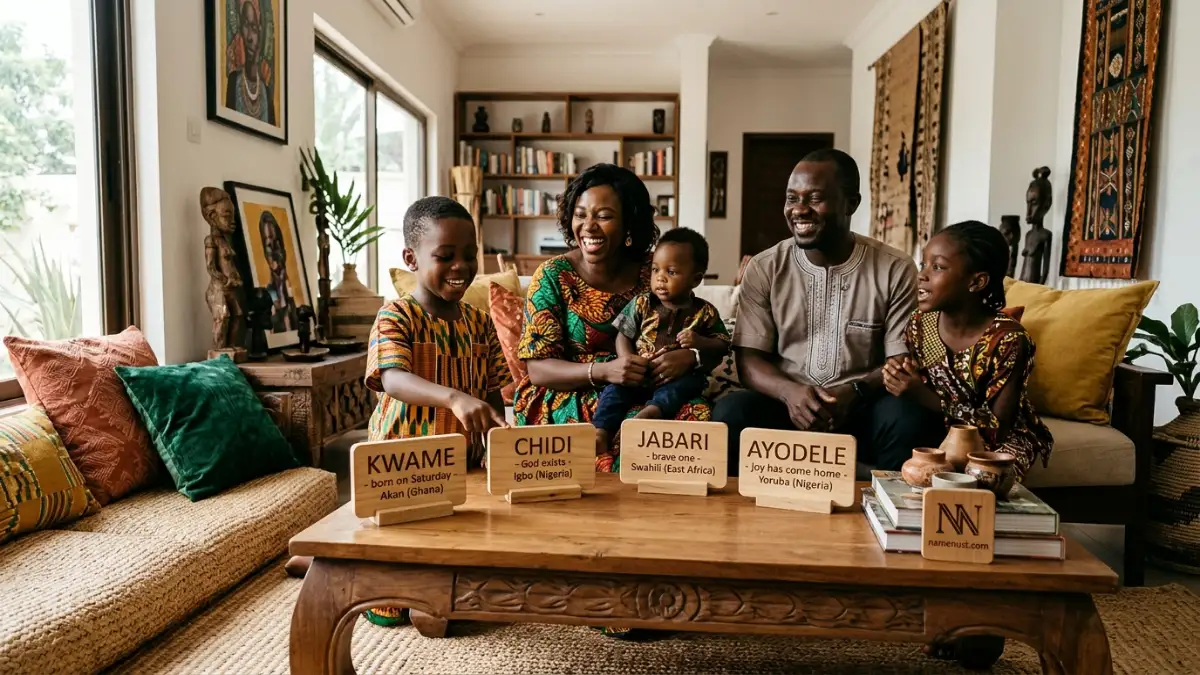
African boy names come from diverse languages and cultural traditions, each with its own meanings and history. Names such as Ayodele (joy has come home) from Yoruba, Chidi (God exists) from Igbo, Kwame from Akan, and Jabari (powerful) from Swahili offer meaningful options for parents. Explore African boy names by origin, meaning, and cultural tradition to find a name that reflects your family’s heritage, values, and preferences.
Choosing an African boy name can be a meaningful way to celebrate cultural heritage, honor family traditions, or find a name with a special meaning. Across Africa, names reflect hundreds of languages, histories, and customs, from Yoruba and Igbo traditions in Nigeria to Akan naming practices in Ghana, Swahili names in East Africa, and Amharic names in Ethiopia.
Some African boy names express joy, strength, blessings, or gratitude, while others connect a child to family relationships, religious beliefs, or the day of birth. Because Africa is culturally and linguistically diverse, each name has its own background and significance.
This guide explores African boy names, their meanings and origins, and practical tips to help you choose a name that feels right for your baby.
African Boy Names and Their Meanings
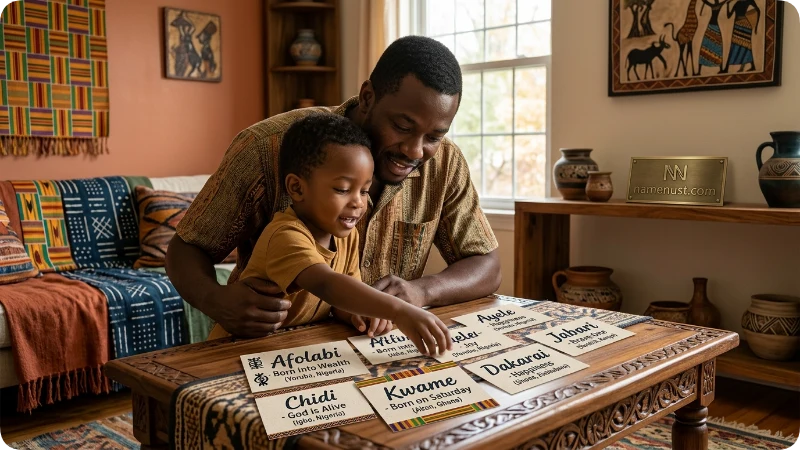
African boy names come from many different languages, and their meanings often reflect the values, experiences, and beliefs of the communities where they originated. The following selections include names with identifiable linguistic backgrounds rather than treating every name used in Africa as belonging to the same tradition.
African Boy Names With Meaningful Origins
These names offer a starting point if you want something distinctive, traditional, or connected to a particular cultural heritage.
| Name | Meaning | Origin or language |
| Afolabi | Born into wealth | Yoruba |
| Ayodele | Joy has come home | Yoruba |
| Ayotunde | Joy has come again | Yoruba |
| Babatunde | Father has come again | Yoruba |
| Chidi | God exists | Igbo |
| Chidiebere | God is merciful | Igbo |
| Chibueze | God is king | Igbo |
| Chibuike | God is strength | Igbo |
| Chibuzo | God is the way | Igbo |
| Chiemeka | God has done a greater deed | Igbo |
| Kwame | Akan name traditionally associated with a boy born on Saturday | Akan |
| Kofi | Akan name traditionally associated with a boy born on Friday | Akan |
| Kwaku | Akan name traditionally associated with a boy born on Wednesday | Akan |
| Kwadwo | Akan name traditionally associated with a boy born on Monday | Akan |
| Kwabena | Akan name traditionally associated with a boy born on Tuesday | Akan |
| Kwasi | Akan name traditionally associated with a boy born on Sunday | Akan |
| Yaw | Akan name traditionally associated with a boy born on Thursday | Akan |
| Ayele | Become strong or powerful | Amharic |
| Bekele | Grow or flourish | Amharic |
| Bereket | Blessing or abundance | Amharic; ultimately related to Arabic baraka |
| Dejen | Foundation or support | Amharic |
| Dawit | Ethiopian Amharic form of David | Amharic |
| Dakarai | Rejoice | Shona |
| Dalitso | Blessing | Chewa |
| Chifundo | Mercy | Chewa |
| Ayanda | They are increasing | Zulu, Xhosa, and Ndebele |
| Bandile | They have increased | Zulu, Xhosa, and Ndebele |
| Dumisani | Praise | Zulu and Ndebele |
| Jabari | Almighty or powerful | Swahili; ultimately from Arabic |
| Baraka | Blessing | Swahili; ultimately from Arabic |
The meanings and language associations above are drawn from established name reference entries, including Behind the Name, and academic research on African personal naming. Some English meanings are concise translations of longer linguistic constructions, so they should not always be interpreted as exact word for word equivalents.
Traditional African Boy Names by Region and Language
One of the most useful ways to choose an African boy name is to start with a specific language or cultural tradition. This makes it easier to understand where a name comes from and whether it reflects the heritage you want to celebrate.
1. Yoruba Boy Names
Yoruba is spoken primarily in southwestern Nigeria and by communities elsewhere, including in the African diaspora. Yoruba personal names frequently communicate ideas through meaningful combinations of words. Some refer to joy, family, wealth, birth circumstances, or religious belief.
Yoruba names can also contain elements whose meaning depends on their place within the full name. A short form may not communicate the same complete idea as the original name.
Consider these examples:
- Afolabi: Born into wealth.
- Adekunle: The crown has filled the home.
- Adegoke: The crown has ascended the mountain.
- Ademola: The crown is with wealth.
- Adeniyi: The crown has honour.
- Adewale: The crown has come home.
- Adeyemi: The crown is suitable for me.
- Ayodele: Joy has come home.
- Ayokunle: Joy has filled the home.
- Ayotunde: Joy has come again.
- Ayodeji: Joy has become two.
- Babajide: Father has awakened.
- Babatunde: Father has come again.
- Bamidele: Follow me home.
- Abayomi: They would have mocked me, referring to the avoidance of an unfortunate event.
These meanings reflect the individual name entries rather than a general assumption about all Yoruba names.
How to choose:
If you appreciate names connected to family, celebration, and joy, Ayodele, Ayotunde, and Babatunde are worth exploring. If you prefer a name associated with traditional ideas of honour or status, Adeyemi, Adekunle, and Adegoke offer different options.
Before settling on a name, consider consulting a fluent Yoruba speaker, particularly if you want to preserve the correct tones and pronunciation. Yoruba is a tonal language, and an English spelling alone does not communicate every pronunciation distinction.
2. Igbo Boy Names
Igbo is spoken mainly in southeastern Nigeria. Igbo naming traditions include names that express a family’s understanding of God, gratitude, life circumstances, relationships, and personal experiences.
Many Igbo names are formed from meaningful linguistic elements or longer expressions. Their significance can depend on the complete name and the circumstances in which it is given. Research on Igbo personal names emphasizes that they can communicate social and cultural information rather than functioning only as labels.
Here are some options:
| Name | Meaning | Naming context |
| Chidi | God exists | Religious expression |
| Chidiebere | God is merciful | Religious expression |
| Chidike | God is strong | Religious expression |
| Chidubem | God is guiding me | Religious expression |
| Chibueze | God is king | Religious expression |
| Chibuike | God is strength | Religious expression |
| Chibuzo | God is the way | Religious expression |
| Chibuzor | Variant of Chibuzo | Related name form |
| Chiemeka | God has done a greater deed | Expression of gratitude |
| Chidiebele | Related to Chidiebere | Variant name form |
These are culturally grounded examples, but the list is not exhaustive. The meaning and appropriate use of a name should be considered in its particular Igbo linguistic and community context.
How to choose:
Chidi is a relatively short option, while Chidubem expresses a more complete idea. Chibuike emphasizes strength in its stated meaning, and Chiemeka can suit parents who want a name that expresses gratitude.
If your family speaks a particular Igbo dialect, ask a knowledgeable speaker to confirm the preferred spelling, pronunciation, and meaning before choosing.
3. Akan Boy Names
Akan naming traditions are especially associated with Ghana and parts of Côte d’Ivoire. One well known practice links a person’s name to the day of the week on which the child is born.
The precise forms vary across Akan speaking communities and dialects, including Twi and Fante. A day name is therefore not simply an arbitrary name chosen because its sound appeals to the parents; it can identify a traditional naming connection.
| Name | Traditional association |
| Kwasi | Sunday born boy |
| Kwadwo | Monday born boy |
| Kwabena | Tuesday born boy |
| Kwaku | Wednesday born boy |
| Yaw | Thursday born boy |
| Kofi | Friday born boy |
| Kwame | Saturday born boy |
These associations are documented in research on Akan naming practices. Alternative forms occur across communities, so a family may use a different spelling or regional form.
How to choose:
If you want a name connected to a child’s birth day and family heritage, an Akan day name may be an especially meaningful choice. Confirm the appropriate form with relatives or a speaker familiar with your family’s tradition.
One important distinction: the traditional day association is not the same as a literal English translation of a name. Kwame, for example, is traditionally associated with a boy born on Saturday; it should not be described as literally meaning “Saturday” without further linguistic qualification.
4. Amharic and Ethiopian Boy Names
Amharic is one of Ethiopia’s major languages. Amharic names include forms rooted in the language itself, names with broader religious histories, and names whose origins connect to other languages.
Ethiopia is culturally and linguistically diverse, so Amharic names and Ethiopian names are not interchangeable categories. A name used in Ethiopia may have an Amharic, Tigrinya, Oromo, Ge’ez, or other linguistic background.
| Name | Meaning or origin |
| Abebe | Flower |
| Abera | Shine, illuminate, or burn |
| Ayele | Become strong or powerful |
| Bekele | Grow or flourish |
| Bereket | Blessing or abundance |
| Berhane | My light |
| Berhanu | His light |
| Dejen | Foundation or support |
| Dawit | Amharic form of David |
| Alemayehu | I have seen the world |
These forms and meanings are recorded in name reference entries for Amharic and Ethiopian usage. Bereket ultimately relates to Arabic baraka, illustrating how names can travel between languages and cultures.
How to choose:
Parents drawn to names with positive meanings might consider Ayele, Bekele, Berhane, or Bereket. If you want a name with a familiar historical counterpart in other languages, Dawit is the Amharic form of David.
For a family with Ethiopian heritage, it can also be helpful to consider the child’s wider naming tradition, including the family’s language, regional background, and naming customs.
5. Swahili Boy Names
Swahili is a major language of East Africa, particularly associated with Tanzania, Kenya, and neighboring regions. Its vocabulary reflects a long history of contact among communities around the Indian Ocean, including Arabic linguistic influence.
As a result, a name used in Swahili may have an Arabic root without being exclusively Arabic in its modern cultural use. Understanding that distinction helps parents choose names for the right reasons.
| Name | Meaning or origin |
| Jabari | Almighty or powerful |
| Baraka | Blessing |
| Daudi | Swahili form of David |
| Faraji | Consolation |
| Hamisi | Connected to Thursday |
| Fadhili | Kindness or favour |
These meanings and associations are documented in established name reference entries. Jabari ultimately derives from Arabic jabbār, while Baraka relates to Arabic baraka. Hamisi is associated with the Swahili word for Thursday, which itself comes from Arabic.
How to choose:
Jabari may appeal to parents looking for a name associated with power, while Baraka offers a meaning connected to blessing. Faraji is another option if you like the idea of consolation.
If cultural origin matters to you, distinguish a name’s current use in Swahili from its older linguistic roots. Both can be relevant, but they describe different parts of its history.
6. Zulu, Xhosa, and Ndebele Boy Names
Zulu, Xhosa, and Ndebele are distinct languages, although some names occur across more than one of these traditions. Shared names should not be treated as proof that the languages or their naming customs are identical.
Two examples have meanings recorded across these languages:
- Ayanda: They are increasing.
- Bandile: They have increased.
- Dumisani: Praise; used in Zulu and Ndebele.
These names illustrate how a meaning can be associated with more than one language.
How to choose:
Ayanda and Bandile may interest parents who appreciate names that express growth or increase. Dumisani offers a different meaning centered on praise.
For families with South African or Ndebele heritage, check how a name is used within the specific community you want to honor. Pronunciation, spelling conventions, and customary usage can differ between languages.
7. Shona and Chewa Boy Names
Shona is spoken primarily in Zimbabwe, while Chewa is spoken in Malawi and neighboring parts of southeastern Africa. Both traditions include names whose meanings can express emotions, experiences, and valued ideas.
| Name | Meaning | Language |
| Dakarai | Rejoice | Shona |
| Dalitso | Blessing | Chewa |
| Chifundo | Mercy | Chewa |
These language associations and meanings are recorded in established African name references.
How to choose:
Dakarai may suit parents who want a name associated with rejoicing. Dalitso and Chifundo offer meanings connected to blessing and mercy.
If you are choosing one of these names for a child in a multilingual family, consider how its original pronunciation will be maintained and whether the spelling needs explanation in the child’s everyday environment.
African Boy Names by Meaning
Some parents begin with a language or region, while others start with an idea they want their child’s name to express. Meaning based categories can help you compare names across traditions without assuming that they share the same cultural origin.
African Boy Names Meaning Strength or Power
If you want a name associated with strength, consider the following options.
- Ayele: An Amharic name meaning “become strong” or “become powerful.”
- Chibuike: An Igbo name meaning “God is strength.”
- Chidike: An Igbo name meaning “God is strong.”
- Jabari: A Swahili name meaning “almighty” or “powerful.”
- Adekunle: A Yoruba name meaning “the crown has filled the home.” Its meaning relates to the crown and household, rather than being a direct translation of strength.
- Dakarai: A Shona name meaning “rejoice.” It is an alternative if you prefer a positive meaning rather than one directly connected to power.
The first four names have meanings that directly or explicitly reference strength, power, or divine might. The last two are included to illustrate how a name can convey a different kind of positive idea without being inaccurately classified as a strength name.
African Boy Names Meaning Joy or Happiness
Names associated with joy can express celebration, gratitude, or the happiness a child brings to a family.
- Ayodele: Yoruba; joy has come home.
- Ayodeji: Yoruba; joy has become two.
- Ayokunle: Yoruba; joy has filled the home.
- Ayotunde: Yoruba; joy has come again.
- Dakarai: Shona; rejoice.
- Desta: Amharic; joy.
These names express different ideas. Ayodele and Ayokunle refer to joy in relation to the home, while Ayotunde expresses the idea of joy returning. Dakarai and Desta offer more direct connections to rejoicing and joy.
African Boy Names Meaning Blessing or Gratitude
If you want a name connected to blessing, appreciation, or gratitude, these options are worth considering.
- Bereket: Amharic; blessing or abundance.
- Baraka: Swahili; blessing.
- Dalitso: Chewa; blessing.
- Chiemeka: Igbo; God has done a greater deed.
- Chidiebere: Igbo; God is merciful.
Bereket, Baraka, and Dalitso have meanings directly connected to blessing or abundance. Chiemeka and Chidiebere instead express religious ideas of gratitude and mercy. These are related in theme, but their meanings and cultural backgrounds remain distinct.
African Boy Names Connected to Family
Family relationships are important in many naming traditions, although the precise ways they are expressed differ.
- Babatunde: Yoruba; father has come again.
- Babajide: Yoruba; father has awakened.
- Ayodele: Yoruba; joy has come home.
- Adekunle: Yoruba; the crown has filled the home.
- Chidubem: Igbo; God is guiding me.
These names do not all express the same family relationship. Babatunde and Babajide specifically refer to the father, while Ayodele and Adekunle contain imagery associated with the home. Chidubem expresses guidance through a religious reference.
Short African Boy Names
Short names can be convenient for everyday use, but brevity does not determine cultural authenticity or meaning. If you want a compact name, consider these options.
| Name | Origin | Meaning or association |
| Chi | Igbo | God or spiritual being; also an element in longer names |
| Yaw | Akan | Traditionally associated with a boy born on Thursday |
| Kofi | Akan | Traditionally associated with a boy born on Friday |
| Kwame | Akan | Traditionally associated with a boy born on Saturday |
| Kwasi | Akan | Traditionally associated with a boy born on Sunday |
| Ayo | Yoruba | Joy; also used as a short form of longer names containing the element |
| Dayo | Yoruba | Joy arrives |
| Dawit | Amharic | Form of David |
| Baraka | Swahili | Blessing |
The meaning of Chi deserves particular care: in Igbo usage, it can refer to a personal spiritual being or God, and it also occurs as an element in longer personal names. Its precise interpretation depends on context.
When comparing short names, consider whether you prefer a complete name, a traditional day name, or a shorter form of a longer name. These are different naming choices, even when the resulting names are similar in length.
Distinctive African Boy Names
A distinctive name does not have to be statistically rare. It may stand out because of its sound, spelling, meaning, or connection to a specific language.
Here are several options from different traditions:
- Adegoke: Yoruba; the crown has ascended the mountain.
- Ayokunle: Yoruba; joy has filled the home.
- Chidubem: Igbo; God is guiding me.
- Chibuzor: An Igbo variant of Chibuzo, meaning God is the way.
- Dakarai: Shona; rejoice.
- Dejen: Amharic; foundation or support.
- Ayele: Amharic; become strong or powerful.
- Dalitso: Chewa; blessing.
- Bandile: Zulu, Xhosa, and Ndebele; they have increased.
- Faraji: Swahili; consolation.
The list deliberately spans different language traditions rather than suggesting that one region or language represents all African naming practices. Meanings and origins are drawn from established name references.
There is no reliable basis here for claiming that these names are universally rare or uncommon. Their familiarity can vary considerably by country, language community, generation, and diaspora setting.
How to Choose the Right African Boy Name
Finding a name you like is only the first step. Understanding its cultural background and deciding how it will fit into your family’s life can help you make a more informed choice.
1. Start With a Specific Cultural or Language Connection
If you have African heritage, you might begin with your family’s country, ethnic community, or language. A Nigerian family, for example, might explore Yoruba, Igbo, Hausa, or other traditions depending on its background. An Ethiopian family might consider Amharic, Tigrinya, Oromo, or another relevant language tradition.
If you do not have a direct family connection, you can still appreciate names from different cultures. Take the time to understand the name’s origin rather than selecting it solely because it sounds attractive.
2. Verify the Meaning in Its Original Language
English language baby name lists sometimes simplify meanings or repeat interpretations without explaining where they came from. A single English phrase may not capture every part of a name’s linguistic structure.
For example:
A name that contains a reference to God may communicate a complete statement or expression of belief. Translating it into a short phrase can be useful, but the shorter version may leave out important context.
Whenever possible, check an established name reference and consult a fluent speaker familiar with the relevant naming tradition.
3. Consider Pronunciation and Spelling
Some African names contain sounds, tones, or letters that may be unfamiliar to people who speak English. Names may also appear in multiple romanized spellings because of differences in local language conventions, colonial spelling practices, or transcription systems.
Before deciding, consider:
- How the name is pronounced in its language of origin.
- Whether its spelling preserves meaningful distinctions.
- Whether commonly used variants represent the same name or genuinely different forms.
- How the name will be written and pronounced in the country where the child will grow up.
You do not need to avoid a name simply because others may need help pronouncing it. Understanding its pronunciation allows you to preserve it more confidently.
4. Think About the Full Name
Say the first name aloud with the child’s surname and any intended middle names. Consider whether the sounds flow naturally and whether the name’s spelling will work well with the rest of the child’s name.
If the name has a traditional meaning connected to family circumstances, faith, or the day of birth, you may also want to discuss that background with relatives.
5. Avoid Choosing Solely on the Basis of a Popularity Claim
A name described as rare on an international website may be familiar within its country of origin. Conversely, a name that is common in one community may be unusual in another.
Without reliable, region specific birth name statistics, it is better to evaluate a name according to your own priorities such as cultural connection, meaning, pronunciation, and family significance rather than accepting an unsupported claim that it is rare or trending.
African Boy Names and Cultural Identity
African names can carry linguistic, historical, religious, and family significance. Understanding these connections helps parents appreciate a name beyond its English translation.
Are All African Names Indigenous to African Languages?
No. Names used in Africa can originate from local African languages, Arabic, Hebrew, Greek, Latin, European languages, or other sources. Over time, names may become established in African communities while retaining connections to their earlier linguistic histories.
For example:
Dawit is the Amharic form of David, while Daudi is the Swahili form. Jabari is used in Swahili and ultimately derives from Arabic. These examples show why a name’s language of use and its deeper etymological origin should be distinguished.
A name does not become less meaningful because it has traveled between languages. Its importance may come from how a community uses it today, as well as from its historical origins.
Are African Boy Names Religious?
Some are explicitly religious, while others are associated with family relationships, birth circumstances, weekdays, emotions, or everyday vocabulary.
For example:
Chidi and Chibuike have religious meanings in Igbo, while Kwame and Kofi are traditionally associated with particular birth days in Akan naming practices. Ayodele expresses the idea that joy has come home in Yoruba.
These names belong to different naming contexts. It would be inaccurate to classify all African names as religious simply because some express beliefs about God or spirituality.
If religious meaning is important to your family, verify the name’s actual linguistic meaning and cultural use rather than relying on a general label such as spiritual or traditional.
FAQs
What are some popular African boy names?
Kwame, Kofi, Kwaku, Chidi, Jabari, Dawit, Babatunde, and Ayodele are examples of names associated with African languages and naming traditions. However, their popularity varies by country and community. Without comparable, current birth name statistics, it would be misleading to rank them as the most popular African boy names overall.
What is a strong African name for a boy?
Ayele is an Amharic name meaning “become strong” or “become powerful.” Chibuike and Chidike are Igbo names meaning “God is strength” and “God is strong,” respectively. Jabari is a Swahili name meaning “almighty” or “powerful.” Each offers a different linguistic and cultural background.
What African boy names mean joy?
Several African names have meanings connected to joy. Ayodele means “joy has come home,” Ayodeji means “joy has become two,” and Ayotunde means “joy has come again” in Yoruba. Dakarai means “rejoice” in Shona, while Desta means “joy” in Amharic.
What African boy names mean blessing?
Bereket is an Amharic name meaning “blessing” or “abundance.” Baraka means “blessing” in Swahili, and Dalitso means “blessing” in Chewa. Although these names share a similar English meaning, they come from different language traditions.
Are African boy names different from African American boy names?
The categories overlap, but they are not identical. African boy names can refer to names from the continent’s many languages and cultural traditions. African American naming traditions developed through a distinct history that includes African cultural connections, European language names, religious influences, family traditions, and modern naming practices.
A name’s African linguistic origin alone does not establish that it originated in an African American community. Likewise, a name used by African American families does not necessarily have an indigenous African language origin.
Can I choose an African boy name if I am not African?
Yes. You can appreciate and choose a name from a culture outside your own, but it is worth learning about the name’s background and using it respectfully. Understand its pronunciation, meaning, and cultural associations, and avoid presenting a name as part of your own family heritage if that is not accurate.
If a particular name has ceremonial, religious, or community specific significance, seek guidance from someone knowledgeable about that tradition.
How can I find an African boy name that matches my family’s heritage?
Start with the specific country, ethnic community, or language connected to your family. Then explore names documented within that tradition and verify their meanings with reliable references or fluent speakers. If you know the language but not the exact regional tradition, ask relatives or community members for guidance.
This approach is more useful than selecting from a broad list of African names without knowing their origins.
Conclusion:
Choosing an African boy name can be an opportunity to celebrate language, family history, cultural identity, or a meaning that matters to you. The most useful starting point is to decide what you want the name to express and then explore the traditions where those meanings are genuinely found.
Yoruba names such as Ayodele and Babatunde offer connections to joy and family, while Igbo names such as Chidi and Chibuike express religious ideas. Akan names such as Kwame and Kofi can connect a child to the traditional weekday naming system, and Amharic names such as Ayele and Bereket offer meanings associated with strength and blessing.
There is no single best African boy name, because each family has different priorities and each naming tradition has its own significance. A name that sounds appealing is a good starting point, but understanding its origin, pronunciation, and meaning makes the choice more informed.

Noah Mitchell is a passionate Name Researcher and Content Writer at Namenust.com. He specializes in creating well-researched content about name meanings, origins, history, cultural significance, and modern naming trends. His goal is to help readers discover unique, meaningful, and inspiring names for babies, businesses, characters, and more. Through informative and engaging articles, Noah makes name research simple, accurate, and enjoyable for readers around the world.