Quick Answer:
Nordic boy names come from the naming traditions of Norway, Sweden, Denmark, Iceland, and other Nordic communities. Many have Old Norse roots, while others reflect later Scandinavian naming customs or come from languages such as Latin, Greek, and Hebrew. Popular choices to explore include Erik, Björn, Leif, Sven, Magnus, and Olav, each with its own linguistic history and cultural background.
Nordic boy names appeal to parents who appreciate Scandinavian heritage, distinctive sounds, and connections to history. Some names come from the Viking Age and Old Norse language, while others are familiar choices in modern Scandinavian countries.
You can also find names inspired by Norse mythology, traditional virtues, animals, and historical figures. Choosing a name becomes easier when you understand its meaning, origin, and regional spelling.
This guide explores traditional Nordic boy names, mythology inspired choices, strong names, short options, and names associated with individual Nordic countries.
Traditional Nordic Boy Names
Traditional Nordic names often have roots in Old Norse, the North Germanic language used in Scandinavia during the Viking Age and medieval period. Some have survived through centuries of use, while others have modern forms that differ slightly from their historical spellings.
| Name | Meaning or association | Origin |
| Erik | Traditionally interpreted as “eternal ruler” or “ever ruler”; the exact etymology is debated | Old Norse |
| Björn | Bear | Old Norse; Swedish form |
| Leif | Heir or descendant | Old Norse |
| Sven | Boy or young man | Old Norse |
| Harald | Traditionally associated with an army and a ruler | Old Norse |
| Gunnar | Associated with battle or warrior related elements | Old Norse |
| Knut | Knot | Old Norse |
| Ivar | Traditional name with a debated etymology involving older Germanic elements | Old Norse |
| Håkon | Traditionally interpreted as “high son” or “exalted son” | Old Norse |
| Arvid | Traditionally associated with eagle and tree or forest elements | Old Norse |
| Ulf | Wolf | Old Norse |
| Sigurd | Traditionally associated with victory and protection | Old Norse |
| Sten | Stone | Swedish and Danish |
| Einar | Traditionally interpreted as “one warrior” or “lone warrior” | Old Norse |
| Olav | Descendant of Old Norse Óláfr, traditionally associated with ancestors and inheritance | Norwegian |
These names offer different ways to connect with Nordic heritage. Björn and Ulf have animal related meanings, while Leif and Einar have historical linguistic associations. Håkon and Olav are especially recognizable in Norwegian naming traditions.
Remember that historical meanings can be more complicated than their modern English translations suggest. When a name’s etymology is disputed, it is better to acknowledge that uncertainty than to assign it an overly specific meaning.
Nordic Boy Names Inspired by Norse Mythology
Norse mythology provides another source of inspiration for Nordic boy names. Its gods and legendary figures appear in medieval Scandinavian literature, including the Poetic Edda and Prose Edda. However, a mythological name is not necessarily a common modern baby name, and a name’s cultural significance may be more important than a direct translation.
| Name | Meaning or association | Mythological connection |
| Thor | Associated with thunder | Norse god of thunder |
| Odin | Name of a major Norse god; deeper etymology is complex | Associated with wisdom, poetry, magic, and warfare |
| Tyr | Name of a Norse god | Associated with war and the keeping of oaths in surviving myths |
| Balder | Adapted form associated with Old Norse Baldr; the etymology is debated | Figure associated with beauty and a tragic death |
| Vidar | Modern Scandinavian form of Víðarr | Son of Odin in Norse mythology |
| Freyr | Mythological name associated with fertility, prosperity, and peace | Norse god |
| Bragi | Name of a Norse god associated with poetry | Norse mythology |
| Heimdall | Name of a guardian figure in Norse mythology | Associated with guarding the gods’ realm |
Thor is a straightforward choice if you want a direct connection to Norse mythology. Odin has a broader mythological association, while Bragi offers a connection to poetry.
These names should be understood in their historical context rather than treated as ordinary words with simple English meanings. Norse mythology includes complex stories and differing interpretations, so symbolic associations should not be confused with established linguistic etymologies.
Strong Nordic Boy Names and Their Meanings
Some parents look for names associated with courage, leadership, protection, or strength. Nordic naming traditions include names whose elements relate to battle, victory, rulers, animals, and weapons. Others, such as Magnus, have non Norse linguistic origins but a long history of use in Scandinavia.
| Name | Meaning or association | Origin |
| Magnus | Great or mighty | Latin |
| Gunnar | Associated with battle | Old Norse |
| Sigurd | Associated with victory and protection | Old Norse |
| Harald | Traditionally associated with an army and rulership | Old Norse |
| Ulf | Wolf | Old Norse |
| Trygve | Trustworthy | Old Norse |
| Geir | Spear | Old Norse |
| Steinar | Traditionally associated with stone and warrior related elements | Old Norse |
| Rolf | Traditionally associated with fame and wolf | Old Norse name elements |
| Arne | Eagle | Old Norse |
These names offer different kinds of associations. Magnus has a direct meaning of greatness or might, while Geir refers to a spear and Ulf means wolf. Strength, courage, and leadership may be symbolic qualities that parents associate with these meanings, rather than literal translations of every name.
If you want a name with a documented meaning, consider the original linguistic elements instead of relying solely on modern baby name lists that describe nearly every traditional name as powerful or brave.
Short Nordic Boy Names
Short Nordic boy names can be convenient to pronounce, easy to spell, and simple to pair with longer middle or family names. Several have Old Norse roots, although pronunciation and familiarity differ across languages and countries.
| Name | Meaning or association | Origin |
| Bo | Traditionally associated with a resident or inhabitant | Scandinavian |
| Leif | Heir or descendant | Old Norse |
| Ulf | Wolf | Old Norse |
| Sten | Stone | Swedish and Danish |
| Knut | Knot | Old Norse |
| Arne | Eagle | Old Norse |
| Thor | Norse god associated with thunder | Old Norse |
| Odd | Traditionally associated with a point or weapon point | Old Norse |
| Finn | Has several historical explanations and uses across cultures | Scandinavian and wider European usage |
| Rune | Related to the Old Norse word for a secret or hidden knowledge | Old Norse |
Leif, Ulf, and Arne are useful options if you prefer short names with established historical associations. Bo is especially brief, while Rune may appeal to parents interested in Old Norse language and history.
Short names are not automatically rare. A name that is familiar in one country may be less recognizable elsewhere, so check regional birth name data if popularity is important to your decision.
Modern Scandinavian Boy Names
Not every Nordic boy name needs to come directly from the Viking Age. Modern Scandinavian naming traditions include names inherited from Old Norse, regional forms of Germanic names, and names adopted from Latin, Greek, and Hebrew.
| Name | Meaning or origin note | Scandinavian connection |
| Emil | Derived from the Roman family name Aemilius; its deeper etymology is debated | Commonly used in Scandinavia |
| Oskar | Germanic name tradition with debated interpretations of its elements | Scandinavian form |
| Aksel | Scandinavian form related to Axel and Absalom | Nordic usage |
| Henrik | Traditionally interpreted as “home ruler” | Scandinavian form of a Germanic name |
| Gustav | Traditional Scandinavian name with debated historical etymology | Scandinavian usage |
| Ludvig | Scandinavian form related to Ludwig; traditionally interpreted as “famous warrior” | Nordic usage |
| Isak | Scandinavian form of Isaac, a Hebrew name traditionally interpreted as “he laughs” | Nordic usage |
| Filip | Scandinavian form of Philip, derived from Greek elements associated with horses and affection | Nordic usage |
| Kasper | Form of Caspar, whose ultimate origin is uncertain | Nordic usage |
| Olav | Norwegian form derived from Old Norse Óláfr | Norwegian |
| Nils | Scandinavian form related to Nicholas | Nordic usage |
| Johan | Form related to John, ultimately derived from Hebrew | Scandinavian usage |
This group illustrates the difference between a name’s linguistic origin and its cultural usage. Emil, Henrik, and Isak can be appropriate choices for parents seeking names used in Scandinavia, even though they do not all originate in Old Norse.
For families who prefer a familiar name that works across several languages, options such as Emil, Oskar, and Henrik may be worth considering. Their pronunciation can still vary by country.
Norwegian Boy Names
Norwegian naming traditions include names with Old Norse roots as well as modern forms and names adopted from other languages. Norwegian spelling preserves characters such as å, æ, and ø, which can give certain names a distinctive appearance.
| Name | Meaning or association | Origin |
| Olav | Traditionally associated with ancestors and inheritance | Old Norse; Norwegian form |
| Håkon | Traditionally interpreted as “high son” or “exalted son” | Old Norse |
| Eirik | Norwegian form related to Erik | Old Norse |
| Sverre | Traditional Norwegian masculine name; precise etymology is uncertain | Norwegian |
| Trygve | Trustworthy | Old Norse |
| Bjarne | Related to names associated with a bear | Scandinavian |
| Kjetil | Derived from Old Norse Ketill, associated with a helmet or cauldron | Norwegian |
| Einar | Traditionally interpreted as “one warrior” or “lone warrior” | Old Norse |
| Åsmund | Traditionally interpreted through elements associated with a god and protection | Old Norse |
| Sigurd | Associated with victory and protection | Old Norse |
Håkon, Olav, and Eirik are particularly useful choices if you want a Norwegian form with historical roots. Names containing Norwegian characters may require additional consideration if your family lives somewhere that does not regularly support those letters in everyday systems.
Swedish Boy Names
Swedish boy names include traditional Scandinavian forms, names inherited from Old Norse, and international names that have become established in Sweden. Swedish spelling uses letters such as å, ä, and ö.
| Name | Meaning or association | Origin |
| Björn | Bear | Old Norse; Swedish form |
| Arvid | Traditionally associated with eagle and tree or forest elements | Scandinavian |
| Sten | Stone | Swedish |
| Ulf | Wolf | Old Norse |
| Gustav | Traditional Scandinavian name with debated etymology | Swedish and wider Scandinavian usage |
| Erik | Traditionally associated with rulership | Old Norse |
| Sven | Boy or young man | Old Norse |
| Nils | Scandinavian form related to Nicholas | Swedish and wider Nordic usage |
| Folke | Traditional Scandinavian name with historical roots; exact meaning is uncertain | Swedish |
| Albin | Derived from a Latin name associated with albus, meaning “white” | Swedish usage; Latin origin |
Björn is a particularly recognizable example of a Swedish form. Its Norwegian and Danish counterpart is generally written Bjørn. The names are related forms rather than entirely unrelated choices.
If you want a name that reflects Swedish heritage, consider whether you prefer the Swedish spelling or a related form used in another Scandinavian country.
Danish Boy Names
Danish boy names include traditional forms with historical roots in Denmark and the wider Scandinavian region. Some spellings differ from Norwegian or Swedish versions, even when the underlying names are closely related.
| Name | Meaning or association | Origin |
| Knud | Related to Old Norse Knútr, meaning “knot” | Danish form |
| Svend | Boy or young man | Danish form related to Sven and Old Norse Sveinn |
| Bo | Traditionally associated with a resident or inhabitant | Danish and Scandinavian usage |
| Niels | Scandinavian form related to Nicholas | Danish |
| Troels | Traditional Danish form associated with the Old Norse name Þórgísl | Danish |
| Bjørn | Bear | Old Norse; Danish form |
| Erik | Traditionally associated with rulership | Old Norse; Danish usage |
| Harald | Traditional name with Old Norse roots | Danish and wider Scandinavian usage |
Knud and Svend are useful examples of how Danish spelling can differ from forms more familiar to English speaking readers. These regional differences can help distinguish a Danish name from a broader Scandinavian choice.
Icelandic Boy Names
Icelandic names are closely connected to the country’s language, which preserves many features of Old Norse. However, Icelandic naming conventions have their own rules and cultural context, so Icelandic names should not simply be treated as interchangeable with Norwegian, Swedish, or Danish names.
| Name | Meaning or association | Origin |
| Einar | Traditionally associated with a lone or individual warrior | Old Norse; Icelandic usage |
| Bjarni | Related to the Old Norse word for bear | Icelandic |
| Guðmundur | Traditionally interpreted as “God’s protection” or “protected by God” | Icelandic |
| Þór | Icelandic form of Thor | Old Norse |
| Ari | Traditionally associated with an eagle in Old Norse | Icelandic and wider Nordic usage |
| Jón | Icelandic form of John, ultimately derived from Hebrew | Icelandic |
| Ólafur | Icelandic form related to Old Norse Óláfr | Icelandic |
| Björn | Bear | Old Norse; Icelandic usage |
Icelandic spelling includes letters such as þ and ð, and names can have grammatical forms that differ from those in other Scandinavian languages. The country’s naming traditions also include patronymic and matronymic surnames, so a person’s full name may follow conventions different from those used in many English speaking countries.
If you are choosing an Icelandic name because of family heritage, it is worth checking its accepted spelling and naming conventions rather than relying only on an English language baby name list.
How to Choose the Right Nordic Boy Name
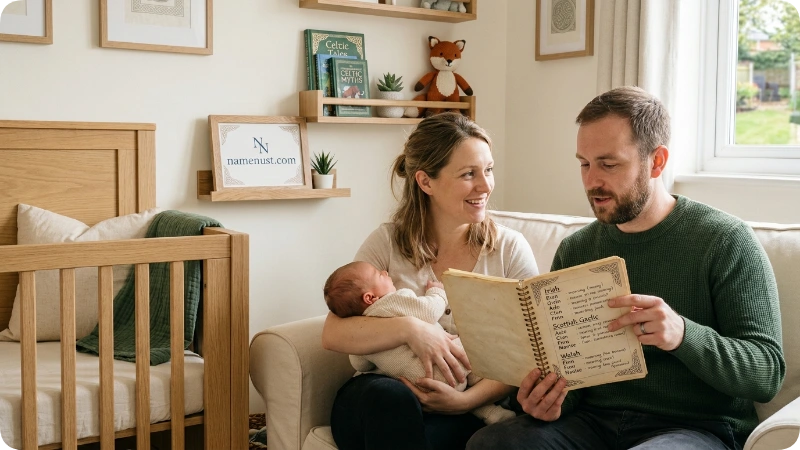
Finding the right name involves more than selecting a meaning you like. Consider how the name connects to your family’s background, how it sounds with your surname, and whether its spelling will work in your everyday environment.
- Choose the cultural tradition first. Decide whether you are most interested in Old Norse names, Norwegian names, Swedish names, Danish names, Icelandic names, or modern Scandinavian usage.
- Check the original meaning. Look for reliable linguistic explanations. Some traditional name meanings are debated, and popular websites may simplify or repeat uncertain interpretations.
- Think about pronunciation. Letters such as å, æ, ø, ö, þ, and ð may be unfamiliar to English speakers. Decide whether you want the original spelling and pronunciation or a more familiar variant.
- Consider the full name. Say the first, middle, and last names together. A short name such as Leif may pair well with a longer surname, while a longer name such as Guðmundur has a different rhythm.
- Look beyond mythology. Norse gods can be a meaningful source of inspiration, but historical everyday names may be more suitable if you prefer a less overt mythological connection.
- Check actual popularity when it matters. Official national statistics are more useful than unsupported claims that a name is rare, trending, or popular throughout the Nordic region.
A thoughtful choice balances meaning, cultural connection, pronunciation, and personal preference. You do not need to select the oldest or most unusual name to find one with a meaningful Nordic background.
Frequently Asked Questions
What are some popular Nordic boy names?
Erik, Björn, Leif, Sven, Magnus, and Olav are recognizable names associated with Scandinavian or Nordic naming traditions. However, current popularity varies by country and year. A name’s historical recognition does not establish that it is among the most frequently given names today.
What Nordic boy names mean strong or powerful?
Magnus means “great” or “mighty” and comes from Latin. Gunnar is associated with battle, while Sigurd has name elements traditionally associated with victory and protection. These names offer different connections to strength rather than sharing the same literal meaning.
Are Nordic boy names the same as Viking names?
No. Viking era names are part of the broader history of Nordic naming traditions, but not every Nordic name is a Viking name. Modern Scandinavian naming includes later regional forms and names adopted from other languages.
Are Nordic and Scandinavian names different?
The terms overlap but are not identical. Scandinavia commonly refers to Denmark, Norway, and Sweden, while the Nordic region also includes Finland and Iceland, along with other territories. Nordic naming traditions therefore include several distinct linguistic and cultural traditions.
Are Finnish boy names Nordic?
Yes, Finnish names belong to the broader Nordic region, but Finnish is not a North Germanic language like Swedish, Danish, Norwegian, and Icelandic. Finnish origin names should be distinguished from Old Norse names when linguistic origin matters.
What are some short Nordic boy names?
Leif, Ulf, Bo, Sten, Arne, and Odd are short options with Scandinavian or Old Norse connections. Their meanings and regional usage differ, so check the specific form you prefer before choosing it.
Conclusion
Nordic boy names offer a wide range of options, from traditional names such as Erik, Björn, and Leif to Norwegian choices such as Olav and Håkon, and mythology inspired names such as Thor and Odin.
Some have clear lexical meanings, while others are best understood through their historical or cultural associations. As you narrow your list, focus on each name’s actual origin, meaning, spelling, and regional context.
Whether you prefer a short name, a traditional Scandinavian form, or a name connected to Norse mythology, understanding its background will help you choose a name that feels meaningful to your family.

Noah Mitchell is a passionate Name Researcher and Content Writer at Namenust.com. He specializes in creating well-researched content about name meanings, origins, history, cultural significance, and modern naming trends. His goal is to help readers discover unique, meaningful, and inspiring names for babies, businesses, characters, and more. Through informative and engaging articles, Noah makes name research simple, accurate, and enjoyable for readers around the world.