Quick Answer:
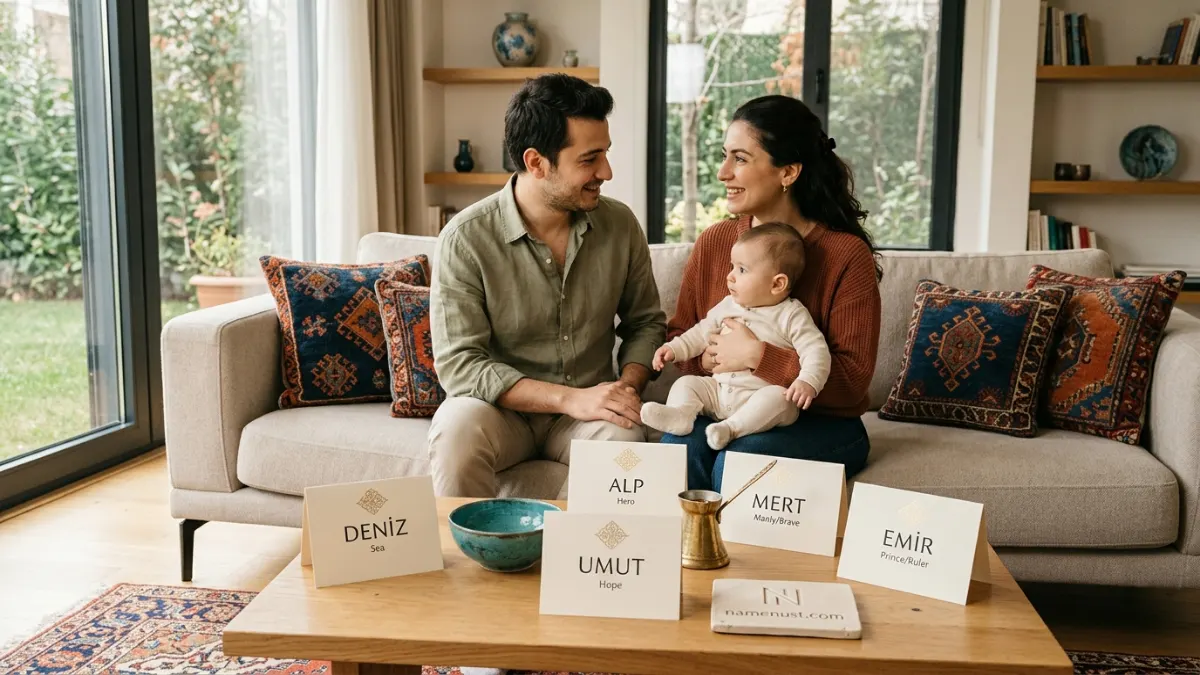
Looking for the perfect Turkish boy name? Beautiful options include Deniz (sea), Umut (hope), Alp (hero or brave warrior), Mert (brave or honest), and Emir (commander or prince). If you prefer traditional Turkish names, modern favorites, strong meanings, or names with Islamic and historical connections, this guide will help you find a meaningful name for your baby boy.
Choosing a name for your baby boy is a beautiful and meaningful experience. You want a name that sounds special, carries a lovely meaning, and reflects your family’s values or cultural heritage.
Turkish boy names offer a wonderful variety, from powerful traditional choices like Alparslan and Yiğit to nature inspired names like Deniz and Kuzey. Some names express courage, strength, and leadership, while others represent hope, peace, and life.
Turkish naming traditions also include names of Arabic and Persian origin that have been used for generations in Türkiye. In this guide, you’ll explore Turkish boy names with meanings, discover different naming styles, and learn how to choose a name that feels right for your little one.
Turkish Boy Names With Meanings
Here is a carefully selected list of Turkish boy names, including traditional Turkish names, nature inspired choices, historical names, and names used in Turkish Muslim families. Meanings are included where they are reasonably established; names with multiple linguistic roots are identified rather than presented as exclusively Turkish.
| Name | Meaning | Origin or cultural context |
| Alparslan | Traditionally interpreted as a brave or heroic lion | Turkic; associated with Seljuk history |
| Alp | Hero, brave warrior | Turkic |
| Alper | Commonly interpreted as a brave man or hero | Turkish compound name |
| Alperen | Associated with a heroic, spiritually devoted person | Turkish; combines alp with eren |
| Aras | A river name | Regional and geographic usage |
| Arda | A Turkish personal name; its precise etymology is not settled in every reference | Turkish usage |
| Aslan | Lion | Turkish usage; ultimately related to a word found across Turkic and neighboring languages |
| Atakan | Commonly interpreted through its elements as ancestor and khan | Turkish compound name |
| Atilla | Turkish form associated with Attila the Hun; its ultimate etymology is disputed | Historical |
| Ayaz | Frost or cold, clear weather | Turkish |
| Aybars | A traditional Turkic compound associated with the moon and a leopard or panther | Turkic |
| Baran | Rain in Turkish usage; also has Persian language associations | Multiple linguistic traditions |
| Barış | Peace | Turkish |
| Batuhan | A compound name associated with Batu and han | Turkic historical naming tradition |
| Berk | Firm, solid, strong | Turkish |
| Berke | Associated with firmness or strength in Turkish naming references | Turkic usage |
| Bora | A strong, cold wind or squall | Turkish |
| Buğra | Male camel; historically used in Turkic royal titles | Turkic |
| Burak | Turkish form of Buraq, the mount associated with the Prophet Muhammad’s night journey in Islamic tradition | Arabic derived; religiously significant |
| Can | Life, soul, or spirit | Turkish usage; borrowed from Persian |
| Cenk | Battle or combat | Turkish usage; Persian derived |
| Cihan | World or universe | Persian derived; established in Turkish |
| Çağatay | A historical Turkic name associated with Chagatai and the Chagatai lineage | Turkic history |
| Çınar | Plane tree | Turkish |
| Demir | Iron | Turkish |
| Deniz | Sea | Turkish |
| Doğan | Falcon or hawk; also a Turkish word meaning “born,” depending on context | Turkish |
| Doruk | Summit or peak | Turkish |
| Efe | Traditionally a brave man or a respected regional leader | Turkish, especially Aegean cultural usage |
| Emir | Commander or prince | Arabic derived; established in Turkish |
| Emre | A Turkish personal name associated with friendship or affection in traditional interpretations | Turkish usage; precise etymology varies by reference |
| Eren | A spiritually mature or wise person in Turkish cultural usage | Turkish |
| Erdem | Virtue or moral excellence | Turkish |
| Erhan | A compound name associated with a man or warrior and a ruler | Turkish |
| Erkin | Free or independent | Turkic |
| Erol | Traditionally interpreted as “be a man” or “be courageous” | Turkish compound name |
| Evren | Universe or cosmos | Turkish |
| Fatih | Conqueror | Arabic derived; strongly associated with Ottoman history |
| Fırat | The Euphrates River | Turkish form of a historic river name |
| Gökay | A compound associated with the sky and moon | Turkish |
| Gökhan | Sky ruler or ruler of the heavens, based on its components | Turkic compound name |
| Göktuğ | A compound associated with the sky and tuğ, a traditional standard or emblem of authority | Turkic |
| Hakan | Ruler or khagan | Turkic title used as a personal name |
| Kaan | Khan or ruler | Turkic title used as a personal name |
| Kaya | Rock | Turkish |
| Kerem | Generosity, nobility, or graciousness | Arabic derived; established in Turkish |
| Koray | A compound commonly interpreted as glowing or ember like moon | Turkish |
| Kuzey | North | Turkish |
| Levent | Historically associated with sailors or naval men; also a Turkish personal name | Turkish and Ottoman usage |
| Mert | Brave, honest, or manly | Turkish usage |
| Mete | Associated with the historic ruler Modu Chanyu, known in Turkish historical tradition as Mete Han | Historical Turkic naming |
| Metehan | A compound combining Mete and han, a ruler’s title | Turkic historical tradition |
| Miran | Used in Turkey and neighboring regions; its precise origin and meaning vary across references | Regional and multilingual usage |
| Murat | Wish, desire, or aspiration | Arabic derived; established in Turkish |
| Oğuz | Name associated with historic Turkic peoples and the Oghuz tradition | Turkic |
| Onur | Honor | Turkish |
| Orhan | Traditional Turkish name associated with Ottoman history; exact etymological interpretations vary | Turkish historical usage |
| Ozan | Poet, bard, or singer | Turkish |
| Ömer | Turkish form of Umar; associated with long life in Arabic etymological explanations | Arabic derived; important in Islamic history |
| Özgür | Free or independent | Turkish |
| Poyraz | A northeasterly wind | Turkish |
| Sarp | Steep, rugged, or difficult to climb | Turkish |
| Selim | Safe, sound, or unharmed | Arabic derived; established in Turkish |
| Serkan | A Turkish personal name with multiple traditional interpretations; meaning depends on the reference | Turkish usage |
| Sinan | Turkish personal name associated with Ottoman history; the exact etymological meaning is not uniformly established | Turkish historical usage |
| Taner | A compound commonly interpreted through tan (dawn) and er (man) | Turkish |
| Tolga | Helmet, especially in historical or military contexts | Turkic |
| Tufan | Flood or deluge | Arabic/Persian linguistic connections; established in Turkish |
| Tuna | Turkish name for the Danube River | Geographic and Turkish usage |
| Umut | Hope | Turkish |
| Ural | Name associated with the Ural region and mountain range; personal name etymology may vary | Geographic association |
| Utku | Victory | Turkish |
| Yağız | Dark complexioned, dark colored, or dusky, depending on context | Turkish |
| Yaman | Powerful, formidable, or capable; can also mean difficult or fierce | Turkish |
| Yavuz | Stern, resolute, or formidable | Turkish |
| Yiğit | Brave, courageous young man | Turkish |
| Yılmaz | Undaunted or one who does not give up | Turkish |
| Yusuf | Turkish form of Joseph; a prophetic name in Islam and a Biblical name | Hebrew origin through religious and linguistic transmission |
| Zafer | Victory | Arabic derived; established in Turkish |
Naming note: Some names above have clear everyday meanings, while others are historical names, titles, or names whose etymology is debated. A familiar Turkish interpretation should not automatically be treated as the word’s original historical meaning.
Traditional Turkish Boy Names
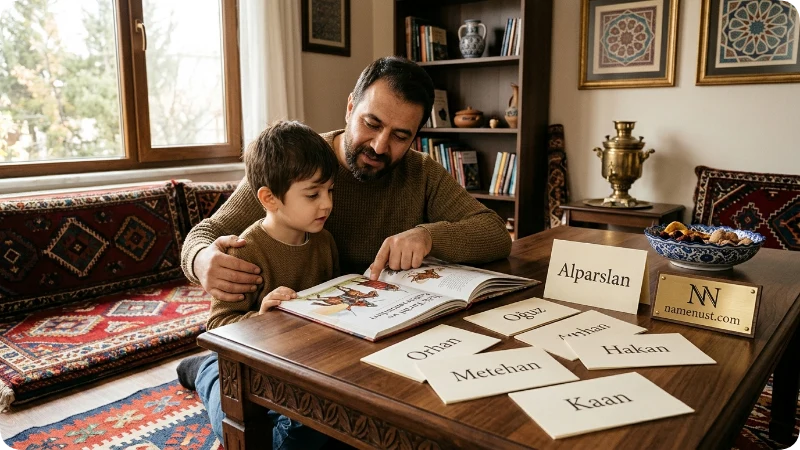
Traditional names can connect a child with Turkish history, family heritage, and older naming customs. Some come from Turkic vocabulary, while others became established through Ottoman history or religious and regional traditions.
Alparslan
Associated with the Seljuk sultan Alp Arslan. The name is traditionally understood through the elements alp (hero or warrior) and arslan (lion). It combines a historic association with a strong, recognizable sound.
Oğuz
Connected with the Oghuz Turkic peoples, whose history has had a lasting influence on Turkish identity. This is a particularly relevant option for families interested in Turkic heritage.
Orhan
Recognized through Ottoman history, including Orhan Gazi, an early Ottoman ruler. It offers a traditional Turkish naming choice with a clear historical association.
Metehan
Associated with Mete Han in Turkish historical tradition. The name is suitable for parents who appreciate historic Turkic leaders and traditional compound names.
Other traditional options include Hakan, Kaan, Alp, Tolga, Atilla, Fatih, Levent, and Yavuz. Their associations are not identical: Hakan and Kaan derive from ruler titles, Fatih is associated with conquest, and several others are historical personal names.
Modern and Popular Turkish Boy Names
A modern sounding name does not necessarily have a modern origin. Some Turkish names have existed for generations but continue to appeal to new parents because they are concise, familiar, or easy to use internationally.
For a useful popularity check, official statistics are more reliable than unsourced online lists. According to Türkiye’s Turkish Statistical Institute (TÜİK), Alparslan, Göktuğ, and Metehan were the three most frequently given names to newborn boys in 2025. The official data also listed Yusuf, Kerem, Miran, Ömer Asaf, Ömer, Atlas, and Aras among the leading choices.
| Name | Meaning or association | Why consider it |
| Göktuğ | Sky and a traditional standard or emblem | A distinctive Turkic compound |
| Metehan | Historic ruler association | Traditional and recognizable |
| Kerem | Generosity or nobility | Familiar across Turkish and other communities |
| Atlas | Name of a figure in Greek mythology; also a geographic and literary term | International recognition |
| Aras | River name | Short and easy to say |
| Kuzey | North | Clear Turkish vocabulary name |
| Eymen | Arabic derived name traditionally associated with good fortune or blessedness | Common in Turkish Muslim naming |
| Miran | Regional name with varying interpretations | Contemporary use across the region |
| Ömer | Turkish form of Umar | Strong Islamic historical association |
| Emir | Commander or prince | Short and widely recognizable |
Popularity changes over time. The names above are not all Turkish in linguistic origin, and their appearance in Turkish birth statistics indicates use in Türkiye, not exclusive Turkish origin.
Turkish Boy Names With Strong Meanings
If you want a name associated with strength, courage, leadership, or determination, these options are worth considering. The distinctions below separate direct word meanings from historical or symbolic associations.
| Name | Meaning or association | Type of meaning |
| Alp | Hero or brave warrior | Established Turkic meaning |
| Alparslan | Heroic lion | Traditional interpretation of a compound |
| Aslan | Lion | Direct word meaning |
| Berk | Firm or solid | Turkish vocabulary |
| Erkin | Free or independent | Turkic vocabulary |
| Hakan | Ruler or khagan | Historical title |
| Kaan | Khan or ruler | Historical title |
| Mert | Brave, honest, or manly | Established Turkish usage |
| Sarp | Steep or rugged | Turkish vocabulary |
| Utku | Victory | Turkish vocabulary |
| Yağız | Dark or dusky | Turkish vocabulary |
| Yaman | Formidable or capable | Turkish vocabulary |
| Yavuz | Stern or resolute | Turkish vocabulary |
| Yiğit | Brave or courageous young man | Turkish vocabulary |
| Yılmaz | Undaunted; one who does not give up | Turkish vocabulary |
A strong meaning is not the same as a religious blessing or a prediction about a child’s personality. These names express linguistic meanings and historical associations, not guaranteed character traits.
Short and Easy to Pronounce Turkish Boy Names
Short names can be convenient for everyday use, especially when relatives speak different languages. However, pronunciation still depends on the language being spoken.
| Name | Meaning | Pronunciation guidance |
| Alp | Hero or warrior | One syllable; the vowel resembles the a in “father” |
| Arda | Turkish personal name; precise etymology varies | AR dah |
| Bora | Strong wind or squall | BOH rah |
| Can | Life, soul, or spirit | In Turkish, approximately jahn |
| Efe | Brave or respected regional leader | EH feh |
| Emir | Commander or prince | eh MEER |
| Eren | Spiritually mature or wise person | eh REN |
| Kaan | Khan or ruler | KAHN |
| Kaya | Rock | kah YAH |
| Mert | Brave or honest | One syllable |
| Mete | Historical name | MEH teh |
| Ozan | Poet or bard | oh ZAHN |
| Sarp | Steep or rugged | One syllable |
| Tuna | Turkish name for the Danube | TOO nah |
| Umut | Hope | Turkish u is close to the vowel in “rule” |
| Yiğit | Brave or courageous | Approximately YEE it, with a Turkish soft ğ |
A useful pronunciation tip: Turkish uses several letters that English does not. The letters ç sound like “ch,” ş like “sh,” and ı represents a vowel that does not occur in standard English. The letter ğ usually lengthens or affects the neighboring vowel rather than sounding like a hard English g.
For example, Yiğit and Göktuğ may need a little explanation when used in English speaking countries. Keeping the original Turkish spelling can preserve the name’s cultural form.
Turkish Nature Inspired Boy Names
Nature inspired names offer a meaningful option for parents who prefer names connected to the natural world rather than titles or historical figures.
| Name | Meaning | Connection |
| Ayaz | Frost or cold, clear weather | Winter weather |
| Baran | Rain in Turkish usage | Rain and nature |
| Bora | A strong wind or squall | Weather |
| Çınar | Plane tree | Tree and longevity symbolism |
| Deniz | Sea | Water |
| Demir | Iron | Natural material and strength symbolism |
| Doğan | Falcon or hawk in one established usage | Birds |
| Doruk | Summit or peak | Mountains |
| Evren | Universe or cosmos | The wider universe |
| Kuzey | North | Direction and geography |
| Poyraz | Northeasterly wind | Weather |
| Tuna | The Danube River in Turkish | Geography |
| Ural | Associated with the Ural region and mountain range | Geography |
Names such as Deniz and Kuzey have relatively direct meanings in Turkish. Other names, such as Tuna and Ural, are more strongly associated with geographic names. These distinctions can help you choose the kind of nature connection you prefer.
Turkish Muslim Boy Names
Many families in Türkiye choose names associated with Islam. Some are names of prophets or important religious figures, while others come from Arabic vocabulary and became established in Turkish through centuries of religious and cultural contact.
A Turkish Muslim name is not necessarily Turkish in linguistic origin, and not every Turkish name has a religious meaning.
| Name | Meaning or association | Religious or linguistic context |
| Ahmet | Turkish form of Ahmad, associated with praise | Arabic derived; associated with the Prophet Muhammad |
| Ali | High or exalted | Arabic; important in Islamic history |
| Burak | Buraq, the mount associated with the Prophet Muhammad’s night journey | Islamic tradition |
| Hamza | A name associated with strength in traditional interpretations | Arabic; associated with Hamza ibn Abd al Muttalib |
| Hasan | Good, handsome, or excellent | Arabic; important in Islamic history |
| Hüseyin | Turkish form of Husayn | Arabic derived; important in Islamic history |
| İbrahim | Turkish form of Abraham | Prophetic name in Islam and Biblical tradition |
| İsmail | Turkish form of Ishmael | Prophetic name in Islam and Biblical tradition |
| Mehmet | Turkish form of Muhammad | Arabic derived; established in Turkish |
| Mustafa | Chosen or selected | Arabic derived; associated with the Prophet Muhammad |
| Ömer | Turkish form of Umar | Arabic derived; associated with an early caliph |
| Osman | Turkish form of Uthman | Arabic derived; associated with an early caliph and Ottoman history |
| Selim | Safe, sound, or unharmed | Arabic derived |
| Yusuf | Turkish form of Joseph | Prophetic name in Islam and Biblical tradition |
If you are selecting a name for religious reasons, check the original form and the specific tradition that matters to your family. For example, Yusuf is a prophetic name, while Deniz is a Turkish word meaning “sea.” Both may be used by Turkish Muslim families, but they have different linguistic and religious classifications.
Turkish Boy Names That Work Well Internationally
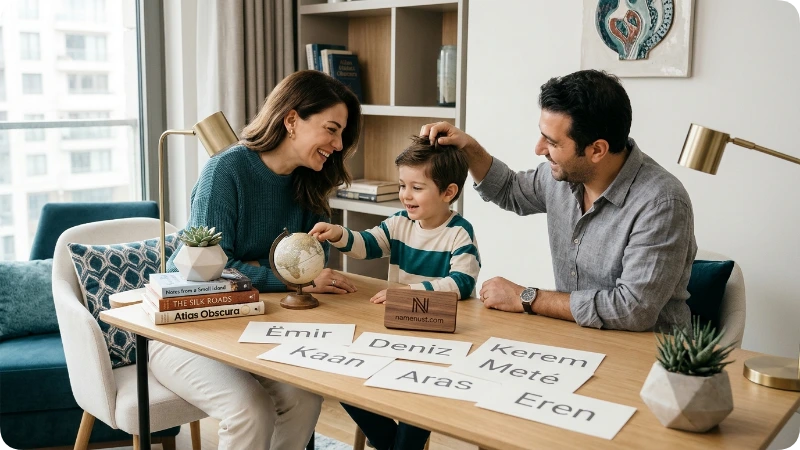
For families living outside Türkiye or raising a child in a multilingual household, it can help to consider how a name will be written and pronounced by people unfamiliar with Turkish.
These names are potential choices because of their relatively compact spelling, recognizable forms, or straightforward everyday pronunciation—not because every language pronounces them identically.
- Emir: Short, with an established meaning and use beyond Türkiye.
- Kaan: Compact and connected to a Turkic ruler’s title.
- Deniz: A clear Turkish word meaning sea, although its pronunciation may need explaining.
- Mert: Short and easy to write, with a Turkish specific pronunciation.
- Aras: Brief and connected to a river name.
- Kerem: Established in Turkish and recognizable in other communities.
- Mete: Short, with a historic Turkic association.
- Can: Very short, but English speakers may initially pronounce it like the English word “can.”
- Eren: Compact and connected to Turkish cultural usage.
- Yusuf: A form familiar across many Muslim communities and other religious traditions.
Before deciding, say the name aloud with the surname, test how it looks in official documents, and consider if you want to retain Turkish characters such as ğ, ş, ı, and ü in everyday writing.
How to Choose the Right Turkish Boy Name
A meaningful name should fit your family’s preferences, cultural connections, and everyday needs. You do not have to choose the longest, rarest, or most historically significant option.
1. Decide what matters most
Start with one priority:
- Heritage: Consider Alp, Oğuz, Alparslan, or Metehan.
- Nature: Explore Deniz, Çınar, Ayaz, or Kuzey.
- Strength: Consider Yiğit, Mert, Berk, or Yılmaz.
- Hope and positive values: Umut means hope, while Erdem means virtue.
- Religious connection: Explore Yusuf, İbrahim, Mehmet, or Ömer, checking the relevant tradition.
2. Check the meaning and origin
Look beyond a short meaning copied from a baby name list. Some names are ordinary Turkish words, some are compounds, and others are borrowed names with a long history in Türkiye.
If the name’s original meaning is important to you, compare a reliable Turkish dictionary or linguistic reference with a reputable etymological source. Historical names may have uncertain origins even when their cultural associations are well established.
3. Say the name aloud
Try the name with your surname and any intended middle name. If your family speaks Turkish and English, consider how both languages handle the spelling and sounds.
4. Consider family and cultural context
A name can connect a child with family history, a regional tradition, a religious figure, or the Turkish language. Ask relatives about family naming traditions if that connection matters to you.
5. Do not confuse uncommon with unique
A name may be unfamiliar to your local community without being statistically rare in Türkiye. To determine if a name is actually uncommon, look for birth registration statistics for a specific country and year.
Are Turkish Boy Names Popular Today?
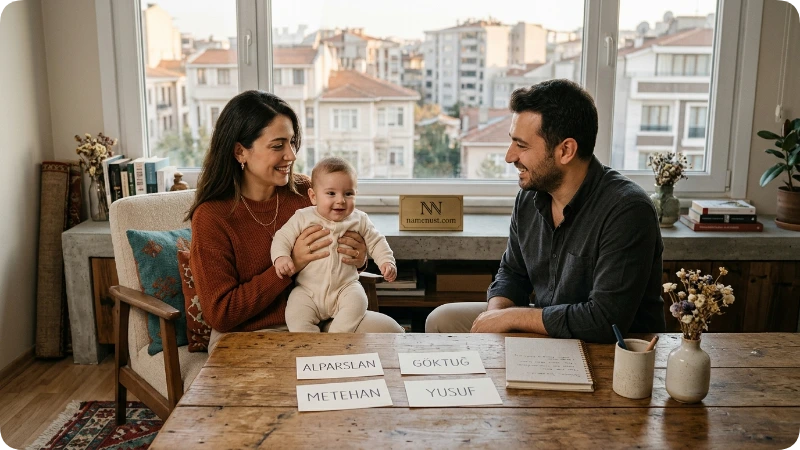
Yes, Turkish names are used across a wide range of styles, from traditional historical names to short vocabulary based names and names shared with other cultures. Official statistics provide a more reliable picture of current choices than general claims about what is trending.
For example, TÜİK’s 2025 newborn name data placed Alparslan first, Göktuğ second, and Metehan third among boys born in Türkiye that year. Yusuf and Kerem also appeared near the top of the national list.
These figures describe newborn naming in Türkiye during 2025. They do not establish which names are most popular among Turkish families living abroad, nor do they measure how rare a name is across the entire population.
For parents who want a less familiar option, it is better to examine the relevant regional or national data than to label a name “rare” based on its appearance.
Frequently Asked Questions
What are some popular Turkish boy names?
Alparslan, Göktuğ, Metehan, Yusuf, and Kerem were among the leading names given to newborn boys in Türkiye in 2025, according to TÜİK’s published data.
What Turkish boy names mean strong or brave?
Alp means hero or brave warrior, Aslan means lion, Yiğit means brave or courageous young man, and Berk means firm or solid. Alparslan is traditionally interpreted as a compound associated with a heroic lion.
What Turkish boy name means hope?
Umut is the Turkish word for hope. It is a direct vocabulary based name rather than a name whose meaning depends on a religious story or historical figure.
What Turkish boy names are inspired by nature?
Deniz means sea, Çınar means plane tree, Ayaz refers to frost or cold, clear weather, Kuzey means north, and Doruk means summit or peak.
Are Turkish boy names always Turkish in origin?
No. Names used in Türkiye come from several linguistic traditions. Deniz and Umut are Turkish vocabulary names, while Yusuf and Ömer are Arabic derived forms with important Islamic associations. Kerem also has an Arabic linguistic origin and is well established in Turkish usage.
Which Turkish boy names have Islamic significance?
Yusuf and İbrahim are prophetic names in Islamic tradition. Mehmet is the Turkish form of Muhammad, and Ömer is the Turkish form of Umar, associated with an early caliph. Other names may be common among Turkish Muslims without having a direct scriptural origin.
What is the difference between Kaan and Hakan?
Both names are associated with Turkic ruler titles. They are closely related in meaning and historical context, but they are distinct personal names and should not automatically be treated as interchangeable spellings.
Are Deniz and Can used as boy names in Turkish?
Yes, both are used as Turkish male personal names. Deniz means sea, while Can is a Persian derived word used in Turkish with meanings such as life, soul, or spirit. Gender conventions can differ across cultures, so check the usage relevant to your family.
How can I find a genuinely rare Turkish boy name?
Start with official birth name statistics for Türkiye or the country where you live. Choose a specific year or period, then compare the name’s frequency with other names. A name that is unfamiliar or historically distinctive is not necessarily statistically rare.
Conclusion
The best Turkish boy name is one whose meaning, cultural background, and sound feel right for your family. If you prefer the historic associations of Alparslan and Metehan, the natural simplicity of Deniz and Kuzey, or the positive meanings of Mert, Erdem, and Umut, there are many options to explore.
Take time to verify the name’s origin, understand its meaning, and pronounce it in the languages your family uses. A thoughtful choice can honor Turkish heritage while giving your child a name that feels comfortable throughout life.

Noah Mitchell is a passionate Name Researcher and Content Writer at Namenust.com. He specializes in creating well-researched content about name meanings, origins, history, cultural significance, and modern naming trends. His goal is to help readers discover unique, meaningful, and inspiring names for babies, businesses, characters, and more. Through informative and engaging articles, Noah makes name research simple, accurate, and enjoyable for readers around the world.