Quick Answer :
Looking for Arabic boy names? Explore meaningful choices such as Amir, meaning “commander” or “prince,” Karim, meaning “generous,” Ali, meaning “high” or “elevated,” and Zayd, meaning “growth” or “increase.” Discover traditional Arabic names, their meanings, pronunciation, and cultural significance to find the right name for your baby boy.
Choosing from Arabic boy names is easier when you understand each name’s meaning, linguistic origin, and cultural significance. From timeless favorites like Muhammad, Ibrahim, and Yusuf to distinctive choices like Rashid and Zayd, Arabic names offer a variety of meaningful options for your baby boy.
This guide explores carefully selected Arabic boy names with their meanings, pronunciation, and historical connections, helping you compare traditional favorites, short names, and names associated with positive qualities.
If you live in the United States or elsewhere, you can find a name that reflects your preferences and family heritage.
Traditional Arabic Boy Names
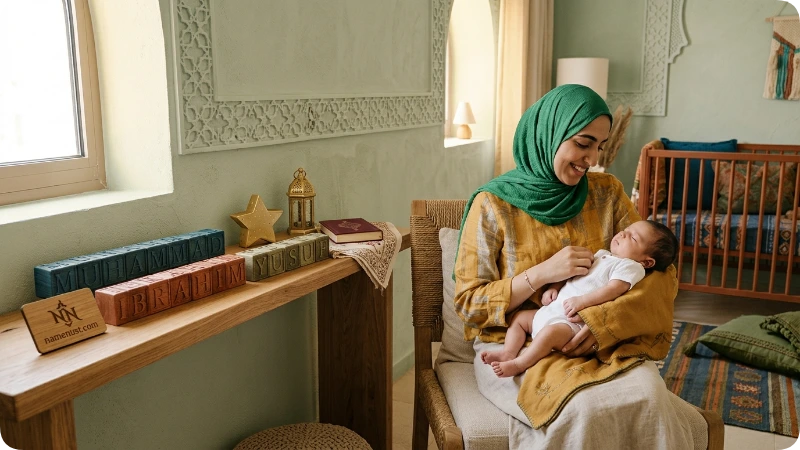
Traditional names can connect a child with Arabic language, family heritage, and generations of naming practice. Some also have important places in Islamic history. However, a name used by Muslim families is not necessarily Arabic in origin, and Arabic names are not exclusive to Muslims.
Muhammad
Meaning: Commonly understood as “praised” or “praiseworthy.”
Origin: Arabic; associated with the Prophet Muhammad and central to Islamic naming traditions.
Pronunciation: moo HAM mad, approximately; pronunciation varies by dialect.
Style: Traditional, recognizable, and religiously significant.
Why it appeals: Muhammad has deep historical and religious importance and is familiar across many countries. English language spellings include Mohammed and Mohammad, although families may prefer a particular transliteration for cultural or personal reasons.
Tag: Documented.
Ibrahim
Meaning: Arabic form of Abraham; the original name’s etymology belongs to the broader Hebrew and biblical name tradition.
Origin: Arabic form of a name shared across Islamic, Jewish, and Christian traditions.
Pronunciation: ib rah HEEM, approximately.
Style: Traditional, cross cultural, and enduring.
Why it appeals: Ibrahim is especially suitable for families who want a name recognized in multiple religious traditions while retaining its established Arabic form. It also offers a straightforward spelling without requiring an unusual English transliteration.
Tag: Documented.
Yusuf
Meaning: Arabic form of Joseph; the name’s deeper etymology is not originally Arabic.
Origin: Arabic; associated with the prophet Yusuf in Islamic tradition.
Pronunciation: YOO soof, approximately.
Style: Traditional, concise, and culturally rooted.
Why it appeals: Yusuf has two syllables and a recognizable English spelling while preserving its Arabic form. It is a strong option for parents seeking a traditional name that also has a familiar counterpart in other religious and cultural traditions.
Tag: Documented.
Arabic Boy Names With Meaningful Qualities
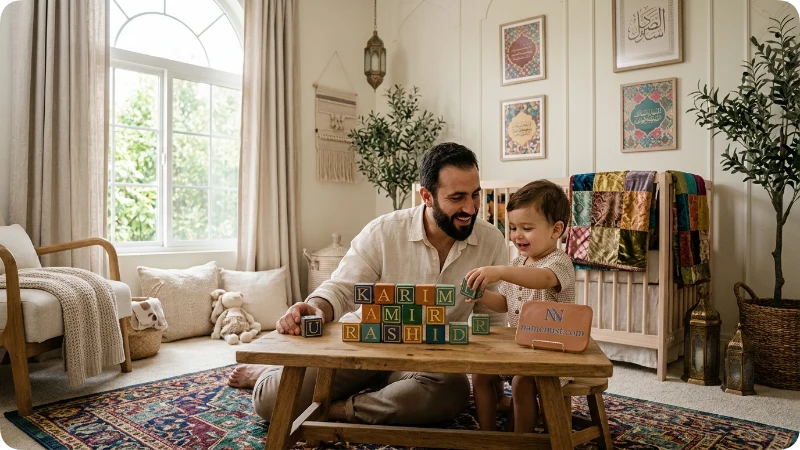
Arabic vocabulary provides many personal names associated with qualities, characteristics, and ideas. These can appeal to parents who want a name whose linguistic meaning is easy to explain. The meanings below describe established Arabic usage rather than predictions about a child’s personality.
Karim
Meaning: Generous, noble, or honorable, depending on context.
Origin: Arabic, from the root associated with generosity and nobility.
Pronunciation: kah REEM, approximately.
Style: Meaning led, familiar, and versatile.
Why it appeals: Karim has a clear positive meaning and a relatively simple two syllable pronunciation for English speakers. It can work well for families seeking an Arabic name that is easy to introduce in multilingual settings.
Tag: Documented.
Amir
Meaning: Commander, leader, or prince, depending on context.
Origin: Arabic.
Pronunciation: ah MEER, approximately.
Style: Short, established, and internationally familiar.
Why it appeals: Amir is compact and generally straightforward to spell in English. Its established use across different communities makes it worth considering for families who want an Arabic origin name that works naturally in American settings.
Tag: Documented.
Rashid
Meaning: Rightly guided; also associated with sound judgment.
Origin: Arabic, from a root connected with guidance and right direction.
Pronunciation: rah SHEED, approximately.
Style: Traditional, meaning rich, and distinctive.
Why it appeals: Rashid offers a meaningful alternative to shorter, more widely familiar choices. Its connection with guidance gives parents a specific linguistic meaning to consider, while its established Arabic usage makes it suitable for a culturally grounded name.
Tag: Documented.
Short Arabic Boy Names for Everyday Use
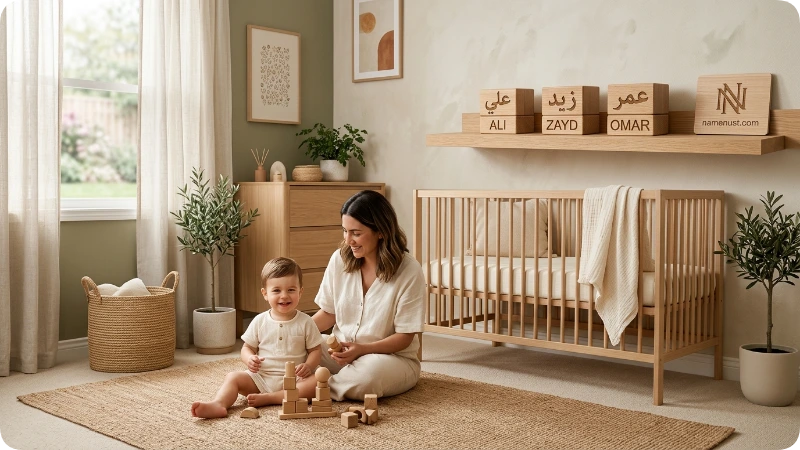
Short names can be convenient on school forms, in professional settings, and in multilingual households. Length alone does not determine pronunciation difficulty, however, and families should consider how a name sounds in their own dialect as well as in American English.
Ali
Meaning: High, elevated, or exalted.
Origin: Arabic.
Pronunciation: AH lee, approximately.
Style: Brief, traditional, and widely recognized.
Why it appeals: Ali is easy to write and relatively simple to pronounce in English. It also has considerable historical importance in Islam, including its association with Ali ibn Abi Talib, making it meaningful beyond its concise form.
Tag: Documented.
Zayd
Meaning: Growth or increase.
Origin: Arabic, associated with a root conveying growth and increase.
Pronunciation: ZAYD, approximately.
Style: Compact, traditional, and distinctive.
Why it appeals: Zayd has one syllable and a clear consonant vowel structure. The spelling Zaid is also used in English transliteration; parents should select the form that best reflects their family preference and intended pronunciation.
Tag: Documented.
Omar
Meaning: Commonly connected with the Arabic root associated with life or flourishing; exact explanations can vary.
Origin: An established Arabic form related to ʿUmar.
Pronunciation: OH mar, approximately in American English.
Style: Familiar, concise, and cross cultural.
Why it appeals: Omar is a practical option for parents who value a traditional Arabic name with a familiar English spelling. The related spellings Omar and Umar reflect transliteration conventions and naming preferences rather than necessarily representing different names.
Tag: Documented.
Arabic Boy Names With Historical or Cultural Connections
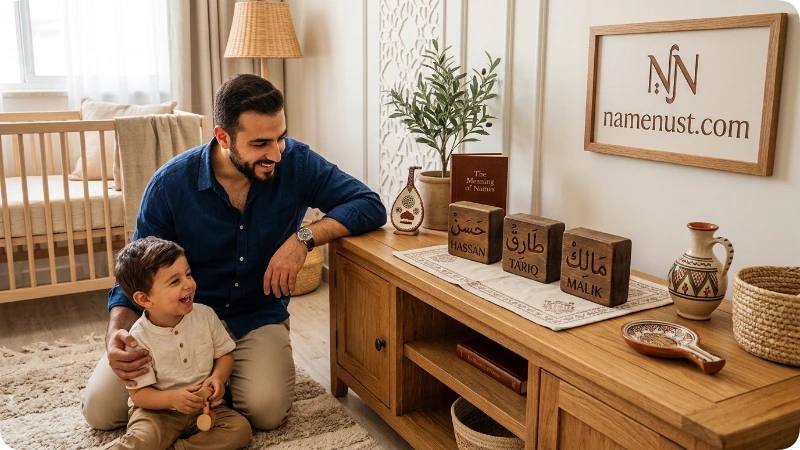
Names associated with historical figures and religious traditions can provide a connection to family heritage. These connections should be understood in context: sharing a name does not establish a person’s religion, ethnicity, or ancestry.
Hassan
Meaning: Good, handsome, or excellent, depending on context.
Origin: Arabic.
Pronunciation: huh SAHN or hah SAHN, approximately; pronunciation varies by language and dialect.
Style: Traditional, recognizable, and historically significant.
Why it appeals: Hassan is associated with Hasan ibn Ali, an important figure in Islamic history. The related spelling Hasan is also widely used, giving parents a choice between established transliteration forms.
Tag: Documented.
Tariq
Meaning: Traditionally associated with someone who comes by night; it is also associated with the Arabic word for a night visitor or one who knocks.
Origin: Arabic.
Pronunciation: tah REEK, approximately in many English language contexts.
Style: Distinctive, historical, and strongly connected to Arabic language.
Why it appeals: Tariq has a recognizable Arabic linguistic basis and historical associations, including the name of Tariq ibn Ziyad, the military leader connected with the early Muslim conquest of parts of Iberia. It suits families looking for a name with both linguistic and historical interest.
Tag: Documented.
Malik
Meaning: King or ruler.
Origin: Arabic.
Pronunciation: MAH lik or MAL ik, depending on the speaker and language.
Style: Concise, established, and meaning led.
Why it appeals: Malik has a clear lexical meaning and a spelling that is relatively easy to recognize. Because the word also has religious and historical uses, parents may want to consider the specific form and context they intend.
Tag: Documented.
More Arabic Boy Names to Compare
The following table offers additional established choices. Pronunciations are practical English language approximations, not substitutes for hearing the name spoken by a fluent Arabic speaker.
| Name | Meaning | Origin | Approximate pronunciation | Style |
| Aali | High, lofty | Arabic | AH lee | Distinctive |
| Adnan | Settler; traditionally linked with ancestral genealogy | Arabic | AD nan | Traditional |
| Akram | Most generous | Arabic | AK ram | Meaning led |
| Anwar | More radiant or luminous | Arabic | an WAR | Traditional |
| Aqil | Intelligent, wise, reasonable | Arabic | ah KEEL | Meaning led |
| Atif | Affection or kindness | Arabic | AH tif | Gentle sounding |
| Hamid | Praiseworthy | Arabic | hah MEED | Traditional |
| Khalid | Everlasting or immortal | Arabic | KHAH lid | Established |
| Salim | Safe or sound | Arabic | sah LEEM | Simple |
| Samir | Companion in evening conversation | Arabic | sah MEER | Familiar |
Meanings and linguistic origins are based on established Arabic name references; English pronunciation can vary with transliteration and regional speech.
How to Choose the Right Arabic Boy Name

Before making a final decision, compare your favorite names using these practical questions:
- Does the meaning matter most? If so, begin with Karim, Rashid, Ali, or Zayd and verify the precise meaning you want.
- How should the name sound in American English? Say the first and last names aloud and consider whether relatives, teachers, and classmates can pronounce them comfortably.
- Do you prefer a religious or linguistic connection? Muhammad, Ibrahim, and Yusuf have important religious associations, while names such as Karim and Salim also offer clear Arabic vocabulary meanings.
- Which spelling reflects your family preference? Consider established variants such as Yusuf/Yousef, Omar/Umar, and Zayd/Zaid.
- Will the name work across different stages of life? Try it in childhood, school, and professional contexts rather than judging it only by its sound for a baby.
The Final Shortlist: 8 Arabic Boy Names Worth Considering
These eight names stand out for their combination of established usage, identifiable meanings or cultural connections, and practical considerations for American families.
| Name | Why it deserves a shortlist place |
| Yusuf | An established Arabic form of Joseph with important religious associations and a recognizable spelling. |
| Karim | A clear meaning associated with generosity and a straightforward English language pronunciation. |
| Amir | A compact Arabic name with established meanings connected to leadership and command. |
| Ali | Short, familiar, and historically significant in Islamic tradition. |
| Zayd | A concise name associated with growth and increase, with an established alternative spelling, Zaid. |
| Ibrahim | A traditional Arabic form of Abraham shared across major religious traditions. |
| Rashid | A distinctive option associated with guidance and sound judgment. |
| Salim | An established Arabic name associated with being safe or sound. |
Frequently Asked Questions
What are some popular Arabic boy names?
Muhammad, Omar, Ali, Amir, Yusuf, and Ibrahim are established Arabic names familiar across many communities. However, their current popularity rankings in the United States should be checked against recent Social Security Administration data rather than assumed.
Are all Muslim boy names Arabic?
No. Muslim families use names from Arabic, Persian, Turkish, Urdu, and many other linguistic traditions. A name’s religious association and its linguistic origin are related but distinct questions.
What Arabic boy names have positive meanings?
Karim is associated with generosity, Rashid with right guidance, Ali with elevation, and Salim with safety or soundness. These are linguistic meanings, not predictions about a child’s character.
How do you choose an Arabic name that is easy to pronounce in the United States?
Try shortlisting names such as Ali, Amir, Omar, and Karim, then say each aloud with your intended surname. Choose an established spelling, and remember that English approximations may not capture every sound in Arabic.
Are Yusuf and Yousef the same name?
Yusuf and Yousef are commonly used English transliterations of the same Arabic name, يوسف. Transliteration conventions vary, so families can choose the established spelling that best suits their preference.
Final Thought
Choosing an Arabic boy name is about more than finding a beautiful sound; it is about selecting a name with meaning, history, and personal significance.
If you prefer the timeless appeal of Muhammad and Ibrahim, the simplicity of Ali and Amir, or the meaningful qualities of Karim, Rashid, and Zayd, there are plenty of established options to explore.
Take time to understand each name’s Arabic origin, pronunciation, and spelling variations before making your choice. Ultimately, the right name is one that reflects your family’s values, honors meaningful cultural connections, and feels special for your child throughout his life.

Noah Mitchell is a passionate Name Researcher and Content Writer at Namenust.com. He specializes in creating well-researched content about name meanings, origins, history, cultural significance, and modern naming trends. His goal is to help readers discover unique, meaningful, and inspiring names for babies, businesses, characters, and more. Through informative and engaging articles, Noah makes name research simple, accurate, and enjoyable for readers around the world.